Showing posts with label caricatures. Show all posts

Sunday, November 13, 2016

Sardi's: Past, Present, and a Drift toward Homeopathic Caricature

Hey kids, been a while since I posted. But this is a long one, so strap in and get some hot cocoa.
Sardi's sits at 234 West 44th Street, NY NY

Back in June of this year, I got to tromp around NYC and, while I was there, I dropped in at the world-famous Sardi's, an old hangout for Al Hirschfeld, the birthplace of the Tony Awards, and hallowed ground for any caricature artist or lover of Broadway shows (I am both). And, owing to my plan-ahead-and-do-things-thoroughly-or-not-at-all philosophy, I emailed ahead and greased some wheels in order to speak to some Sardi's staff, have dinner there, and also visit the archived Sardi's drawings at the New York Public Library. I dug into some research, bought the book on Sardi's (Off the Wall at Sardi's, by Vincent Sardi, Jr., and Thomas West, Amarna, 1991 & 2012), and recorded a long interview with Ivan Lesica, the Maitre D' there, in an effort to really understand the evolution of Sardi's. I'd bitten off a lot and had plenty to chew on, yet I was torn about how to share all this. It would have made a fun podcast or article for Exaggerated Features, but nothing came together. Finally, I decided to bang this out on the day before the ISCA convention, simply because I felt others might enjoy knowing some of the stuff I found out. And because sleep and I are mortal enemies.
 

Sardi's Heyday and the NYC Public Library Collection


Really, it's okay if I touch this? Well then . . .
     Anyone my age and older knows the feel of a good, solid library; we remember life and research BG (before Google), when card catalog drawers were picked over and the Dewey Decimal System was your friend--your bizarre, dyslexic friend who made no sense but was still your friend because he knew where stuff was kept. So I was delighted to head over to the Billy Rose Theater Division of the New York Public Library and make arrangements with special collections to pore over the caricatures held there. Yeah, turns out ANY OLD NUTTER CAN JUST WALK IN AND GET A LIBRARY CARD AND GET THEIR FILTHY PAWS ON BOXES UPON BOXES OF THESE PRICELESS CLASSIC WORKS OF ART! FOR FREE!! Who knew?

My face when handling stuff only adults should touch.
     A couple of very helpful librarians walked me through procedures: You enter kind of an academic "quarantine zone" where you are not allowed to bring in books or bags or such of your own. Yellow paper and golf pencils are made available to take notes, and cameras are allowed (as are cell phones). I and a few rows of other researchers waited for our materials to be brought up, then we sat and pieced through our treasures under the watchful eye of the curator, behind her desk at the front of the room. Some collections require the viewer to wear white gloves for the protection of the artifact--I urged the librarian to give me the gloves, so my finger oils would not tarnish the artwork, but she just looked over the record and told me to handle them by the edges please. I took care and handled each piece carefully, reading the inscriptions scrawled on decades ago by Broadway luminaries who expressed their feelings about being flattered, gutted, or simply fed at the establishment of Vincent Sardi, Sr. After six hours, I left with fifty or sixty photos and a list for the curator of pieces that were missing from the boxes--hopefully they will be found, but Sardi's does have a reputation for artwork walking away mysteriously.

Four of Alex Gard's victims.
     The personality of these characters really does seem to shine through, and with my (albeit limited) knowledge and experience in the craft, I swear I could pick out little moments of the artwork being made. Sardi's first artist, Alex Gard, was a Russian refugee who agreed to draw patrons there in exchange for two meals a day. [Note: Wikipedia's entry on Gard states the contract was for one meal a day, but the book and the Maitre D' both told me it was two]. And he was clearly drawing his subjects from life, not from publicity photos. It looks like he sat with them, at a booth or table, and sketched these out while chatting, observing their demeanor, posture, and their dignity (or lack thereof). Many of these early caricatures are profiles, some contain quite a bit of the body, enough to show body language, while some are simplistic . . . but nearly all of them have more bite than polish. The patrons bit back, here and there--when they autographed their picture (as was the rule: no caricature went on the wall unless the artist and subject had both signed it), quite a few celebrities wrote a line or two praising, teasing, or making a pun of their artist's name. Gard have mercy! En Gard! Praise be to Gard! Only Gard can make a Tree! (that last one was scrawled lovingly by Lady Viola Tree). It was clear these folks had formed a rapport with Alex Gard, who obviously would have been a staple in the restaurant if he was eating his requisite two meals a day there.

Gard's drawing of theater critic Ward Morehouse.
     According to the book, and to Sardi's legend, Gard and Sardi had a formal agreement: Sardi was not allowed to complain about the caricatures, and Gard was not allowed to complain about the food. Talk about a recipe for some great, loose, fun artwork: no rules, no prescriptions or proscriptions of how the drawing should look, and that all-important relationship with the subject. With the right rapport, a stroke of the pen that might offend instead becomes a stroke of truth that all can find humor in. But a personal "relationship" can swing both ways: once when the head of the New York Stock Exchange came in and asked to be put on the wall, Gard told the man to his face "You I wouldn't draw for ten thousand dollars" (Sardi & West, p. 23). I found it interesting that the true insult in that day and age, rather than being drawn too harshly, was not being drawn.

Mackey's Bob Hope has his eye on you.
     I'll not spend too much time running down the history of each artist, but suffice it to say that Gard was the Sardi's artist from 1926 until his death in 1948, and he created more than 700 caricatures for the restaurant. Sardi asked Al Hirschfeld to take over (the two were good friends, and I spotted a drawing of Al done by Don Bevan on the second floor), but "Al worked on a scale that looked right for the Times, and his style was really suited to black-and-white" (Sardi and West, p. 70) Vincent Sardi wanted all the work in his restaurant to be colorful. John Mackey took over for a while, but before too long he and Sardi parted ways--according to Sardi, Mackey drank a bit too much. Before his departure, he managed to draw major figures like Henry Fonda, Ethel Merman, Bob Hope, and Alec Guinness among others. The Mackey drawings up at Sardi's Off the Wall show skill but are definitely not quite consistent. The Bob Hope is beguiling in its impish side-stare, but a few others (like Arthur Miller and Alec Guiness) look like an entirely different artist did them. Perhaps Mackey's style depended on his blood alcohol level?


Gorgeous shapes and color in Bevan's work.
     Don Bevan, Sardi's next official artist, is credited in Off the Wall as having drawn caricatures of his fellow detainees after being shot down over Nazi Germany while serving as a gunner in 1943. He later sent some of the drawings to the families of his fellow prisoners, which alarmed some of the mothers, who thought that Don's exaggerated drawings reflected their sons' actual condition! (Sardi and West, p. 77). After his time in World War II, Bevan came to the job after a stint cartooning with the Baltimore Sun and a few forays into theater work himself. His caricatures have a softer feel to them, most relying on colored lines instead of a harsher black line drawing--but his shapes are solid, and his punches are not pulled, not even for the ladies. His graphic style reminds me of a less abstract David Cowles, with elegant shapes and blocks of color, very little crosshatching.

     Bevan drew for Sardi's until he retired in 1974, at which time a contest was held and a young student named Richard Baratz won the honor with his rendition of the inimitable Bette Midler. And, according to both Mr. Lesica and Off the Wall, the Divine Miss M was not pleased with it and refused to sign the thing. Sardi sums up his reaction to this beautifully, in a quote I think all caricaturists should have tattooed upon their person: "Not that I was after another Gard, but it takes a really good caricaturist to offend his subject. After all, for an actor, having your caricature done is like a bad review from a critic; asking an actor what he thinks about critics is like asking a fire hydrant what it thinks about dogs" (Sardi and West, p. 108, emphasis mine). It made me a little sad to know that Midler was soon redrawn so that her caricature was more to her liking.     

     Richard Baratz holds his post until this day, though sources are split on exactly how long he's been Sardi's caricature artist (Sardi's website bio states 29 years, but 1974 to present would be 42 years) or even if he is the "sole caricature artist" as the website also claims. There are quite a few pieces on the walls by Marilyn Church, done in the early 1990s, though she is not mentioned in the Off the Wall book, nor is she found on any online sources that list the official artists of Sardi's, and Ivan could not remember exactly how she came to lend her talents to the restaurant. The evidence is hanging plainly on the wall, however, and I salute you, silent lady among the caricature gents of the ages!
Baratz's engraving influence can be seen in the elegant crosshatching he has applied to Tom Wopat's neck and the faces of Jesse Tyler Ferguson and Yul Brenner.

     Baratz's evolving style is something you can track on the wall . . . he has done over 900 caricatures for the place and counting. There are some real gems among his earlier caricatures, while his later work shows the intricate and painstaking workmanship one would expect from someone in Baratz's "day job" of engraver at the U.S. Treasury. Looking closely reveals delicate crosshatching, evenly spaced and arranged to create tone and mass. His drawings seem to have become less loose over the years, but there is a consistency that reigns throughout. Sure, he missed on likeness here and there, but there are some very solid hits. And the misses weren't due to swinging hard and pounding the ball foul--the misses were due to pulling the bat in and trying to bunt, safely, until the ball just didn't go very far. I found myself wondering as I stared at a few of the drawings, "How much of the pull back on that was Baratz, and how much was the effect of outside forces?" I doubt I'll ever know. But remember, this was the kid who had impressed Vincent Sardi because he could offend his subject.


Current Views on Sardi's and Homeopathic Caricature


     Now, we all live in our own bubbles these days, right? So be aware that what follows is what I've experienced in my bubble. I share my bubble with a few hundred caricature artists who work all over the world, and some knowledgeable fans and historians of caricature, so it's at least a sampling of opinion among folks in the industry.
"Where'd my crags go?" asks Brian Cranston (perhaps).

     Perhaps because of Sardi's long, storied history, many artists today hold the place to a high standard when it comes to what goes on the walls (or around social media). Release parties for new caricature unveilings are now spread around online, and some artists have certainly made their opinions known about the lack of "bite" many of the newer pieces seem to have. What seems to be happening, in my observation is a slow dilution of the art form--which, I hasten to point out, is very likely not the fault of Richard Baratz. It's nostalgic and naive to think that any artist working today might have the same freedom as Alex Gard, who was working in what was then a very low-stakes environment with a no-complaints clause in his supposed verbal contract. Now, however, we live in a day and age of artsy filters instantly applied to digital photos, washed-out lighting that makes 50-year-olds look as smooth as they were when they were at 25, and of course, the customer-is-always-right approach to almost everything, including things a customer is often wrong about (like their own appearance).  
I'd like to see the source photo--it had to be an odd angle.

     You need only work one birthday party as a professional caricature artist to see that people can be touchy about their face . . . and if you have an art director (or owner of a restaurant) in charge of making sure no celebrities get rubbed the wrong way, well, it's a foregone conclusion that the direction things will drift naturally is toward a more dilute, "nice" approach to the caricatures. (Are they still caricatures past a certain point? More on that later. )

Elisabeth Moss has delightful features to caricature . . . someday.
I have come to think of it as homeopathic caricature. Homeopathy is the misunderstood snake oil--um, I mean alternative medicine--that is sold widely in pharmacies and drug stores as a curative but actually contains nothing of substance. Developed in the late 18th century by Samuel Hahnemann, homeopathy is based on the (totally wrong) principle that the more dilute a substance, the stronger effect it will have. If garlic or duck liver or Himalayan salt will act as a curative for some condition, then watering that ingredient down will make it even better. It's a philosophy one would never want from one's bartender, but for some reason people fall for it when it comes to their health. Homeopaths take this dilution prerogative to absurd lengths, emptying out a vessel and refilling it with pure water dozens or hundreds of times so that it's statistically improbable that even one molecule of the garlic, or duck liver, or salt remains in the finished product. And customers pay for water (well, water put into sugar tablets)--and they do so happily and eagerly, thinking that since it has no harsh elements it will not harm them and they can enjoy a placebo effect at least. Are you still with me through that long metaphor? Watering down might make things seem more palatable, but it kills the effectiveness--both of medicine and of caricature.


     While the smoothed-out, very lightly treated faces of Cranston, Krakowski, and Moss certainly contain more than a molecule of likeness, they ring as watered-down rather than concentrated. And concentration of what makes a face unique has always been the raison d'etre of caricature. The old guard (no pun intended) of Gard, Hirschfeld, and Covarrubias were pumping out strong, intense caricatures that were boiled down to capture a person sometimes using just a few lines.
Look at how bland! Oh wait, it's the Osmonds. Nevermind.

     Trawling around the net, I found that professional caricature artists weren't the only ones bristling about the homeopathic dilution of caricature in the hallowed halls of Sardi's these days. On a thread at BroadwayWorld.com, I found a string of comments from regular non-artist Broadway fans who also seemed to miss the spicier variety of caricature. (Apologies to Mr. Baratz if you are reading this, but every Broadway actor has had to deal with bad reviews, so I'm going to go ahead and quote a few, warts and all--and I'm only sampling a small bit of what's there, these Broadway fans even mention that it's a topic that has come up a lot):

"The recent ones have all been so dreadful! I'm genuinely shocked that nobody has complained to them, and that they themselves haven't noticed the dreadful quality of the work. I feel genuinely bad for all the actors who have to stand in front of photographers pretend like their portrait is good."

"After viewing some of the most recent Sardi's Caricatures, especially Neil Patrick Harris, is it me, or are they not very good? Whenever I see an artist doing caricatures on the street, I tend to notice what they have drawn vs their model. Most, if not all have a very good likeness. I had one done several years ago, at Universal Studios Hollywood, which is extremely good. I just don't see the same likeness with the 'professional.'"

"WOW that's a lousy likeness."

"The current artist is seems to think that everybody's noses are smaller than they are. Maybe it's a stylistic choice? If so, it's a bad one."

"All of the recent caricatures have been disgracefully bad."
Wait, Norm Lewis is black?

"I've never been to Sardi's, do the portraits have a little description saying who it's supposed to be?  Or is it some sad game of 'Guess Who?' that no one ever wins?"


"Elizabeth Moss holding a caricature of Nicole Kidman."

"Amen! They aren't caricatures OR portraits. If the artist isn't going to do the exaggerated caricature style, at least draw something that actually looks like the person."

"I guess no one told them that Norm Lewis is black!" 


    Even these non-artist commenters (I assume they were non-artists, with names like "NJBroadwayGirl" and "TheaterGuy") were pointing out what seasoned caricaturists on other forums had complained of: features that might possibly be interpreted as "offensive" (noses, darker skin tones, wrinkles of any kind) were whitewashed out or understated to the point of losing a likeness. I wanted to ask Sardi's about this trend, and whether scaling back exaggeration was something ordered by the celebrities, by publicists, by the owner of the restaurant himself, or whether the drift just started happening naturally as Baratz drew for them year after year while also working as an engraver. 


Sardi's Visit


     The front canopy with its art deco aesthetic beckons you in like you're a resident of the City, it's upscale but downbeat, chic but shabby, very mid-town. I'll dispense with the food review since no one ever goes there for the food. A few caricatures are visible in the front windows (these get rotated around frequently, they tell me), and upon entering you see many more in the little bar to the left and a coatroom area to the right.

The secret key to finding faces!
     In that coatroom I was greeted by a surprise--one that took me a while to process. Overwhelmed by the sheer array of caricatures everywhere, I blankly looked at the coat-check girl (who looked familiar, but in my line of work EVERYONE starts looking a little familiar, so you kind of block it out after a while) and asked about my appointment with the public relations person there. While I waited, the young lady answered some questions and showed me the big green folder they use to track where each caricature is in the building (with multiple floors and little alcoves, it takes some organizational effort to make sure patrons wishing to find their favorite celebrity can be pointed there quickly). 

     Then after we'd spent a few more minutes together, the young lady helping me says "I know where I know you from now! YOU WENT TO AUSTRALIA!"

     Holy cripes, it all hit me . . . she was a little older now, but four years ago she was a new high school graduate who went on a group tour in Australia with her grandmother, and I was one of the thirty-odd people who was on that trip. Madeline! We had ridden camels together and she'd been prone to breaking out into showtunes--so how fitting that she had ended up working on Broadway so soon. Good for her! We were delighted at this bit of evidence that the world can be a small place sometimes.

PHOTOGRAPHIC PROOF, y'all! On the left, back in 2012 on some godforsaken camel farm in the Outback, and then almost exactly four years later, on West 44th Street.

       After our little reunion, I was passed off to Ivan Lesica, who was a very charming and patient man with the grace of a seasoned host. He answered all my questions and even got a kick out of some of the new things he learned as I shared with him a few things gathered from my trip to the library. Ivan has been working at Sardi's for 23 years now, and he certainly had seen many a star come through the place. He kindly let me record our talk, and I took up nearly an hour of his time.

     Our full interview might be available soon, maybe I'll find a place to host it or offer it as podcast fodder for Ali or Cory's caricature podcast endeavors. But for now I'll go over some of the main things that struck me as we chatted.

    One of the first questions I had was I asked Ivan what his definition of a caricature was. His immediate response was that it was similar to a star on the walk of fame, "definitely a tribute." I nudged him and said it was interesting that he didn't think of likeness or exaggeration first. He said "Not anymore . . . Oh, back in the day [there] used to be caricatures that exaggerated the features and everything . . . but now it's more like a cartoon portrait, and basically the honor of being on the wall and joining all these famous, incredible artists."

Marilyn Church's Charlton Heston.
      As to the mysterious Marilyn Church, Ivan recalled that she did some caricatures in the 90s, but wasn't clear on why or how long she worked with the establishment. Her Charlton Heston and Nathan Lane (among a few others) stand out as a more loose, painterly style.

     Ivan told me of something of the release parties for new caricatures and how the performer is invited, along with family and crew members, to a special private celebration on the top floor. He had no memory of anyone being really upset with their likeness in recent times, though he said one or two actors had been very very nervous wondering what to expect but ended up pleasantly surprised that in the drawing the feature they were worried about had been toned down--nose reduced, etc. "Like plastic surgery?" I asked. "Yes!" he said, they were so happy to see that. I was wincing a little as he recounted the story . . . for some that's a happy narrative, but to a caricature artist it's a slow exsanguination of what I love about this craft.

     He continued on, saying that the days of Broadway stars throwing epic tantrums in Sardi's over their caricatures are definitely over . . . which I kind of felt was a pity, as I'd read so many exciting accounts of that very thing in the Off the Wall book. It was almost like Vincent Sardi, Sr., had been a pioneer in the same sort of shock value and celebrity gawking we see in reality TV today: he very deftly poked at the egos of the day an there were regular instances of hissy fits, dramatic accounts of ripping art off the walls, and the odd prima donna refusing to come back to the place until she was placated in some way. But that's all in the past. Nowadays, Sardi's wanted to make sure there were no sore feelings. "We're happy, they're happy, everybody's happy."
Ivan with his favorite caricature, Sir Anthony.

     The most popular caricatures that people seek out these days, according to Ivan, are Kermit the Frog, Lucille Ball, and Liza Minelli, Elizabeth Taylor, and (more recently) Lin Manuel Miranda. When asked which one was his favorite, Ivan spoke highly of Baratz's first official caricature for the place: a young Anthony Hopkins when he won the Tony Award for his performance in Equus. He kindly took it off the wall and posed for a photo with it. Something about the eyes, he kept telling me--it mesmerized him on his first day at work, and he still stops and stares at it every time he passes it. I was happy to see Ivan moved by the work. It really did capture something ineffable about the young Hopkins. "It's exaggerated but at the same time it's so beautiful," he said wistfully, as if those two things are expected to be exclusive--when in caricature, they go hand in hand.

All the drawings on display are actually laser copies. The real ones are kept in a vault, as it's become a regular thing for the art to walk off the walls. Ivan says he's never been aware of the stolen prints ending up on Ebay or some such, and they have caught a few people in the act. Someone had just attempted to steal Bob Hope prior to my visit there.

As to what kind of influence various people have on the choices the artist makes, Ivan stated that, to his knowledge the public relations reps, the agents, and the stars themselves do not have a say in the artwork beyond providing the source photo. (Which is, granted, having a pretty big say . . . if the caricature is made using just one photo, then that's a very limiting way to approach getting a full likeness.) The subject does not see the caricature before the unveiling, but Sardi's owner, Max Klimavicius, does look at a preliminary sketch and suggest changes if he feels they are needed.  

A Letter from Max


     The business owner is always the first and last word when it comes to how that business is run--even if the business is a hallowed institution for a large group of people who feel a sense of ownership themselves. So Max makes the rules. This March 2016 GrubStreet article quotes him: “There are basically three rules for the wall,” the owner explains. “First of all, you have to be a friend of the house. Just because you are famous it doesn’t mean you get a picture. Second, you have to be in the arts. And third? Third is for the exceptions to the other rules.”

     I did email Max Klimavicius and asked him some follow up questions (politely, as I am not in the business of gotcha journalism), inquiring about the stylistic drift and exactly how much concern for actors' ego went into the drawings these days. While Mr. Klimavicius was very polite in his response, his note also contained a disavowal of the art form--which, again, is his right as a business owner. He and he alone determines what goes on the wall. 

     Responding to my query on exaggeration in the recent caricatures, he took issue with the word itself: "Though we refer colloquially to our collection as caricatures, in point of fact, for over 40 years we have been presenting stylized portraits of Broadway’s stars who are friends of the restaurant." Caricature? Stylized portrait? I know, I know, it's potato poh-tah-toe for a lot of folks. He ended his letter with a request: "But since this collection does not technically conform to the caricature category, I ask you to permit us to withdraw and disengage.  Thank you very much and best of luck in all of your endeavors."


Zach Trenholm's work needs no label.
     Okay, well then, consider my above blog to be about stylized portraits instead of caricatures. Sardi's has been a beacon for caricature artists--I mean stylized portrait drawers--for most of the past century, and I will continue to pop in there whenever I am in New York City. In the heart of the theater district, the establishment has survived plenty of years and will continue to thrive, I think, regardless of ups and downs in the quality of food on the plates and art on the walls. If Richard Baratz steps down one day, I look forward to seeing what new blood might season the visual smorgasbord there . . . If I were the one who made the rules, my pick would be Zach Trenholm, whose strikingly accurate yet graphic and shape-reliant style invokes a real spirit of Broadway and theater caricature at its best. Likenesses are readable from across a crowded restaurant, and will help cause a restaurant to be crowded in the first place. Look him up, Sardi's, I'm rooting for you!


Monday, April 13, 2015

Miami Fair: Bodacious Butts, Contagious Colds, Creepy Clowns, Happy Lesbians, and Stockholm Syndrome

Ah, Miami. I got back just several days ago, back to the sweet, sweet desert where humidity is low and eyebrow maintenance is not the number-one priority for most residents.

Yes, all eyebrows were "on fleek" in Miami. To the point where I began to grit my teeth every time I heard some girl exclaim that. It's amazing how two words can sound like bizarre new slang one day and sound like a tired, hackneyed phrase just a few weeks later.

But despite my sarcastic complaints, South Florida really does have its perks. And its perky body parts. See, it's a melting pot of South American, Latin, Caribbean, African, and all sorts of people. I could go into history and culture and race and genetics, but I'm not playing the academic here. I'm looking at it from a cartoonist's point of view. OH MY GOD, THE BUTTS! Sooooo many different kinds. The big booties, the little booties, the angular booties, the pert booties on tall volleyball-player-looking Amazons, the muscular booties on trans women so gorgeous it makes you feel inferior to be cis, the droopy bums on ladies whose salsa-dancing days are behind them, the perfectly round bubble booties, the booties that looked like they'd been drawn by Milo Manara, the booties that looked suspiciously like they'd been enhanced.


Yeah, I looked. I had time to look. It was kind of a slow fair. And in one respect I was grateful it was kind of a slow fair--as I caught the mother of all colds during the second week there. Two of our crew had already gotten the virus, and when you stay in close quarters (like a camper with a very small communal space), one disease vector is all you need. I was coughing until my whole body ached, my throat felt like sandpaper, and I apologized to so many of my customers as I gagged and sneezed and hacked my way through their pictures. It was just enough of a cold to make you miserable as you worked, but not enough to pull you completely from the workforce.

I eventually found my way (or, rather, Sara drove my sick ass) to the Walgreen's clinic, where I paid $120 for a nurse practitioner to look me over, swab me for Strep, and send me off with some prescription cough meds. They seemed to help, or maybe the visit just coincided with the natural end of the virus's reign over my bronchial system.

The fair was down a bit, in terms of attendance and numbers, and Miami has always had a late-night flavor to it. Lots of sitting around during the daytime hours, then we are always rushed as the last couple hours wind down. The same vendors were there, including Hector and his family, the purveyors of the best chimmichurri-drenched meat in Miami. Anthony Bourdain has not yet found Hector, and that's his loss. He only sets up at the Miami Fair and in one other Florida fair, so if you are in the neighborhood during the right time of year, and you see the little blue-and-white Argentinian Grill, do yourself a favor and try Hector's meat.

This guy didn't even pay. He just
squeaked and waved at us. Jerk.
This year there were a few changes. A couple of Miami Fair mascots bobbed their way around the fairgrounds, scaring the utter shit out of some of the kids. All the adults just felt sorry for whomever was stuffed inside those costumes during the hot, humid Miami afternoons. There was a butterfly habitat, where you could dip Q-tips into sugar water and feed the monarchs that flew around the bus-sized enclosure, trying to avoid the already sugared-up toddlers trying to grab them.
Fuck you, but gently,
like a butterfly.

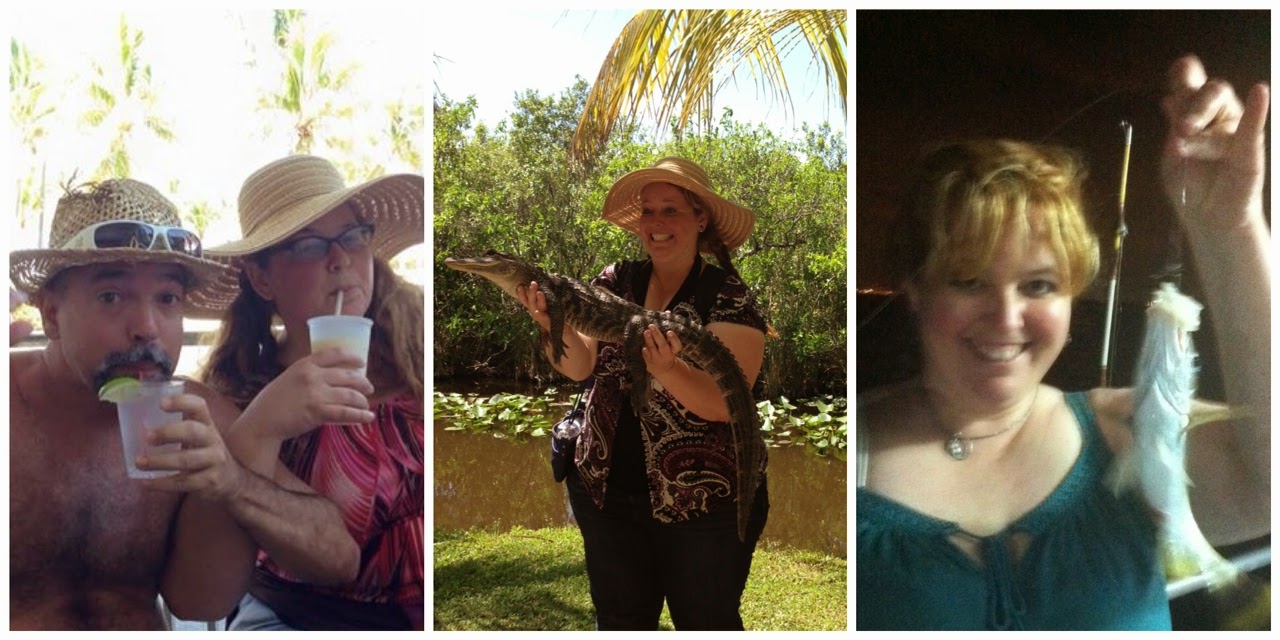
 2015 also presented us with a unique scheduling twist: we actually all had four "days off," when everything was closed up. So for the first and last Monday/Tuesday we enjoyed a short respite from the carny life and got to go play Florida tourists. In those precious days off, several of us squeezed in a night-time fishing trip, a tour of the Everglades, and a night in South Beach. During that last week, we even got to spend time with Al-Rod and Michael White, two awesome Florida artists and longtime ISCA pals. That last day off was really a perfect day, and even worth the wicked sunburn I ended up with (despite multiple applications of SPF bazillion).
Florida wildlife: Michael White, a gator, and a "grunt" fish.

Which made it all the more difficult to head back to the fair. Workers grumbled that the days off kind of threw their rhythm out of whack. It was unusual, for sure, and I was glad to have the opportunity to go hang out with old pals, but I'm not sure I'd vote for that same structure next time around (ha, like we get a vote). It kind of felt like we were putting the fair-finishing celebration in the middle of the job instead of at the end. I and the other artists (and the rest of the fair folk) are really used to hauling ass for a few weeks and THEN getting time off.
By Lar de Souza

Otherwise though, the fair was much as I remembered it from last year. The clickety-clack of marionettes dancing hypnotically in the puppet booth near us. The overpriced fried food. The ants in the camper, and outside the camper, and around the camper. One of my hero artists, Lar de Souza, was moved by my Facebook complaints and kindly drew me as a "Carny Disney Princess" complete with ants and a vegetarian anteater sidekick. That made my week.

There were also the creepy clown garbage toppers. I have only seem them at Florida fairs, and they just . . . aren't right. In fact, Miami native Al-Rod even mentioned that he'd not been to the fair in years but remembers those things creeping him out as a kid. While they are all over the place in West Palm and Tampa, I only saw a couple of them in Miami. But, to my surprise, I got a photo message from a friend of mine visiting South America during that same stretch of time--and it was a picture of a fucking clown head garbage topper in Ecuador, where they were "inexplicably and unnervingly everywhere."
A Miami clown (left), a decapitated Miami clown (middle), and their Ecuadorian
 cousin (right). Though a little worse for wear, that South American clown is
 clearly from the same mold as others in Florida. Be afraid, be very afraid!

Now, I'm no conspiracy theorist, but the clowns are clearly up to something. Not sure if they are actually alien spawn crawling their way up (or down) the American continents, feeding on our refuse until they hatch from this latent form into who knows what . . . or if they have been planted there by government agents and genetically modified to eat certain children that wander by, thus controlling our population while they spy on us. But I'm fairly sure it's one of the two. Wake up, sheeple!

Oh yeah, and I drew pictures while I was there. Honestly, I wasn't too thrilled with much of my work this year. Maybe it was the sickness, or the days off, or the more leisurely pace with thinner crowds, but it took FOREVER to get into that "groove" we all strive for. Even with a less groovy groove, I'm glad I was there. I will still seek out retail stints like fairs, as a matter of personal development, for as long as I'm able. Gigging just does not give you the rounded experience as a caricature artist. Tipsy party guests who aren't paying for their picture can let you slide into mediocrity before you realize it. Working by yourself most of the time doesn't help. Nah, as aggravating as retail can sometimes be, I value those days where I'm working next to a bunch of other artists, with a critical, impatient, cheap grandma (or abuela) hanging over your shoulder judging your every line. That will keep you sharp. Or, at least, tell you when you're losing your edge. Or it might drive you bitterly out of the business--it can have that effect too. Results are not guaranteed.

There was one couple I remember pretty well, and I believe I gave them a nice picture--though I didn't photograph it. They were a couple of ladies, one more feminine and one more butch, who happily announced to me that they had just become engaged. They asked if I could put that in the picture. Well of course! I had done so for many couples before--one of them showing off the ring, the other smiling, both looking at each other, with a little heart that said "She said YES!" floating above them. Now, as I drew this picture I could not help but think about the new religious freedom laws in Indiana and Arkansas that were all over the news that same week. I hadn't realized it, but I am in an industry where I sometimes provide things for same-sex weddings. And here I was, in a situation where I could do a little thought experiment. I started wondering (silently, of course) what it would be like if I were religiously opposed to same-sex unions and chose to express that religion by denying these ladies a picture celebrating their engagement.

Wow, I thought, what an asshole move that would be. It would literally have ruined their day. And not in the typical "Oh my god do I look like that??" way that caricaturists can ruin your day. I mean in a demeaning, dehumanizing, hard-to-ever-laugh-about-later kind of way. What a stain on an otherwise special moment. As the hypothetical situation played out in my head, I literally cringed imagining the emotional harm one could do, even as a retail jockey selling a lousy $30 product (or AWESOME $30 product, as caricatures are).

But maybe I can invent a religion that requires me to refuse service to jerks. I could maybe get on board with that--goodness knows I've certainly put up with plenty of not-so-great people in my chair, and I've drawn them with a smile on my face simply because they had money and waited in line just like everyone else. Though I have heard some stories of ballsy artists rejecting customers (one of the other benefits to working a fair is that you hear stories of exploits on the road). At the Syracuse fair, one kid reportedly waited in line for 40 minutes with his girlfriend, then when they finally got into the artist's chair the smug teen said, "Twenty bucks to draw both of us, or we walk!" The artist chuckled, immediately motioned the kid away and shouted "NEXT!" His girlfriend looked angry and hurt as she skulked off with him, and she was likely rethinking her choice in the dating pool. Hopefully the young man learned a valuable lesson on haggling: it's completely ineffective if you have to wait in a line of eager customers first. One of my coworkers at this fair confessed that he had completely bailed on a picture a few fairs ago. The guy started with a request, then kept piling on more and more requests and warnings about how he didn't want it drawn, until he finally killed the artist's will to even begin the drawing. Without a word to the customer, the artist simply got up and left. Eventually the guy realized he'd been dumped and wandered away.
This baby was not a jerk (though she
did look worried as I started drawing). 

We all have moments when we'd rather not draw someone because they are drunk, arrogant, vain, obnoxious, argumentative, paranoid, cheap, or all of the above. But two ordinary, not-acting-like-jerk people in love? Hell, I'll draw that all day long, no matter what sets of genitals they own. The two ladies loved their picture, by the way, and I told them it would reduce well and make a neat save-the-date card if they felt so inclined.

And so ended the Miami County Fair. Even the long fairs, even when you're sick through them and business isn't great, and there's ants in your camper, you feel weird when it all comes to an end. Sara described it as "Fair Stockholm Syndrome," where you get used to the living situation and routine to the point where you kind of love it. But you hate it. But kinda love it. Sara and I had settled into a living situation like two primates at the zoo: she scratched my sunburned back and I picked stray hairs off her shirt for her. Then we'd screech angrily at people and fling our poop at them. Well, not really. But we thought about it pretty hard.

Until next time, Miami. Keep your eyebrows on fleek while I'm away.

P.S. A quick shout-out to Ali Thome, who has started doing a podcast on caricature called "It's Supposed to be Funny," available on Itunes, and Nolan Harris & Jon Casey who have been doing a podcast called "The Iscast" over on Soundcloud. Both of them are welcome additions to the caricature community, and I especially enjoyed Ali's last episode dealing with the whole "cookiecutter" debate that boiled over and got pretty divisive on a few Facebook pages last month. I look forward to listening to more of what they all have to say in coming episodes--and you should too!  


Thursday, September 4, 2014

Caricaturing for Uncle Sam

That time between starting a drawing job and "the big reveal" can seem excruciatingly long--and with most live drawings it's only a matter of minutes. In this case, it's six years. 

It all started in early 2008, when I got an email from a potential client who wanted to know if I could work from photos. Well, yeah, of course. He further explained that he would like to commission a few dozen black and white caricatures, suitable for reproduction, for a project. Well, that set off my reproduction rights radar and I asked about what sort of project, how many copies, etc. etc. 

Some clients get vague when I ask details like this--they are either trying to get a bargain basement price, or they really don't have much of an idea themselves. This fellow, to my surprise, bypassed vague and simply answered in the negative. No, he could not tell me anything about the project. And I would not be at liberty to publicize it. He said he worked with the government and then he asked if I would be all right working from very bad photos, some of them of corpses. 

Well, this was turning into an interesting little email exchange. I learned that the people I would be drawing were warlords in Afghanistan. Maybe "warlords" isn't the right word. "Power players" might be more apt, definitely more politically correct. My initial (overblown) fears that this job might get a Fatwa put out on me were assuaged as he explained that the drawings would not be anything that would ever endanger my life in any way. This was, remember, around the time that Danish cartoonist was in fear for his life after drawing a controversial image of Mohammed. 

We struck a deal, and he began sending me photos of the subjects--often along with color commentary about their personalities, the regional clothing or hats they were wearing, and whether I should emphasize the mean look in their eye or instead focus on the playful expression they had in another photo. And yes, a couple of them were really awful, fuzzy photos and a few were post-mortem. I did my best. My contact was very supportive, telling me when I was going in the right direction and, overall, he was happy with the results. 

Then, much more recently, he emailed to tell me that the work he had done in Afghanistan was amping down as the situation there got less tense, and so he was able to talk openly about what the caricatures were used for. And, likewise, I am now allowed to post a few on this blog. He also kindly answered a few questions, which I am publishing below . . . 


1. Can you describe what the caricatures were used for?

Certainly! The caricatures that I engaged you to do were personalities that were already controversial public figures. Their affiliations were well socialized in the media. The caricatures you provided were chosen and designed to aid in illuminating the Afghanistan problem for folks tasked with bringing stability to the region.  Specifically, the caricatures continue to serve a three-fold purpose. Firstly,  they have been used to develop a baseline knowledge of the major power-brokers in the Afghanistan region. Secondly, they have been incorporated into a board game as a training tool (not commercially marketed at this time) that incorporated aspects of intent and agendas of these figures. Lastly, they will serve as a legacy to those who dedicated much time and energy into Afghanistan and especially those whose sacrifice was great.

When 911 enveloped our nation and the world in a dark and angry fervor, our best military minds and the brightest in the Intelligence Community were stymied by the concept of the War on Terror that was about to be waged. Thrust into a scenario that modern warfare had left behind by half a century in the remote country of Afghanistan, all the sophistication that the western civilized world could bring to bear proved to be an utter mismatch for the challenges that lay ahead.

It quickly became apparent that planning to "win" in Afghanistan was a far more complex proposition than one could imagine. There was no overarching doctrine to embrace or exploit. The local rules of engagement were varied, archaic, and involved concepts beyond what most westerners could grasp.

It became evident that--as with meeting with success in any conflict--that an eventual hearts and minds campaign would be essential. To do so, the world had to understand Afghan motivation and thinking. Only then could a lasting peace be created after two decades of constant war. To do so meant becoming knowledgeable on tribal dynamics, local interpretations of Islam and fundamentals of Afghan politics, custom, and culture.

Kept for many years among limited numbers who have been working behind the scenes to make Afghanistan a better place, these caricatures which greatly aided as avenues to insight into the Gordian Knot that is Afghanistan can now be shared as part of this blog portfolio.

2. Why did you consider caricatures for this project?

Each of these power brokers in Southwest Asia--ally, enemy and in-between--had huge personalities. They were political as well as militant. Some went on to take positions in the current Afghan government. Some are still waging war or jockeying for power. Some have since been killed in combat or assassinated. Their personal histories were each audacious, outrageous, arguably larger than life. In the truest sense of political satire cartoons universal to publications around the world, each were prime to be immortalized in caricature!

As the Taliban leadership had chosen to side with Usama Bin Laden, the anti-Taliban forces of the Northern Alliance instantly became allies to the west. They were intimately familiar with Afghanistan's rugged terrain. They knew when horses were preferable to tanks, and when donkeys were preferable to horses. 

But, each of these Northern Alliance leaders (soon to be re-dubbed warlords) had individual agendas. Each were power brokers in their own right. Each were accustomed to employing brutal means to an end. To keep these individuals from reverting to infighting, they had to be understood. 

3. Was there any worry (from you or others) that caricatured likenesses might be seen as offensive by the culture or individuals at hand?

There is always concern when cross-cultural references are made--especially in cartoons. Knowing how sharable and popular caricatures tend to be, I did seek consultation. No one thought that any mayhem would ensue. I have been prepared to address any issues. Likewise, if your role as a caricature artist comes under fire, you can honestly say that I never told you the identities of the persons you were sketching at the time. Or since, you now know (years later) who they are/were, you are empowered to field any inquiries yourself.  

Culturally speaking, only one caricature was remotely religious in nature.  The purely fictitious Mullah Nasruddin serves as the foundation of much of Southwest Asian humor.  No believable chance of crossing any redlines there.  As far as the Northern Alliance personalities, outside of complaints based on vanity, risk is/was low.  As for the adversarial opposition figures, of the many "western" acts that they would deem offensive, we assessed caricatures to be quite far down on the list.

4. How did the target audience respond to the game, and the images? Did caricatures work better than photographs for your purposes?

Reactions have been unanimously positive. Many, if not most, have been gamers to some degree or another, so it was not a difficult sell. After all, the term "The Great Game" was coined in the 1800's by Authur Conolly, an intelligence officer in the British East India Company's Sixth Bengal Light Calvary and popularized in Rudyard Kipling's novel, Kim (1901) to describe the conflict between the British and Russian empires for supremacy of Central and South Asia. It was only natural to capture many of the same dynamics in the same region in an actual game depicted in recent times. Caricatures tend to add much more dimension to persons of interest than photos.  Captured in a genre akin to political cartoons, caricatures tend to emphasize the interactive social aspects of these characters. My aim was to impart a better understanding of the nature of the power networks in Afghanistan, how influence works, and to provoke thought about how actions taken in Afghanistan would have secondary and tertiary effects on these networks and influence. With this in mind, caricatures were preferable.

I thank him for kindly taking the time to shed so much light on what the drawings were used for, and painting a picture of the challenges he and his colleagues faced in understanding and communicating such a complicated array of forces and intents. 
Some of the inked originals, including "Mullah Nasruddin," a character who
(along with his donkey) is the source of many jokes in the region. I also learned
about different hats worn in Afghanistan, not just turbans but pakols and kufis.

Sometimes, at the booth, when I draw soldiers, I thank them for their service and jokingly say "Thank you for serving--because I would be terrible at it. What could I do, draw funny pictures and throw them at the enemy?" It always gets a chuckle. But it does also take my mind to this particular assignment, which is probably the only time I'll get to feel patriotic because of having drawn funny pictures. It's a good feeling. A danger in this business is feeling like none of your work matters, like it's all fluff, and you're not really contributing to humanity in any meaningful way (this is an overwhelming feeling when you've just worked a party full of toddlers or drawn a very drunk party girl who can barely remember how to open her purse to pay you). But this one, I'll hold onto this one for a good while. 

While I'm at it, I should also point out the tremendous work that the National Cartoonists Society does with the overseas troops year after year. I have gotten to read all about the USO trips Tom Richmond, Ed Steckley, and many others have taken in order to spread some good humor to the men and women serving abroad. The pen may not actually be mightier than the sword, but it can be put to good use! Have fun drawing, and remember, you never know how important your next project will be.  

Wednesday, July 23, 2014

How to Be a Rookie

The retail operation where I sometimes grab shifts is now welcoming a handful of rookies onto the roster. As a result, I find myself proffering some hints and lessons here and there.

Which takes me back to when I was a rookie (and believe me, I feel like I'm a rookie on a regular basis--this is not a job where you learn everything in the first week and then never pay attention again).

Unlike other professions that take on apprentices formally, with guidelines, caricature operations really vary. Some folks have to adhere very specifically to a house style and medium, while at other places it's a free-for-all. But there's a certain set of unwritten rules in this business when it comes to learning the craft as a newbie. I decided to write them down.

1. Be Nice.

I don't mean "draw nice." I mean BE nice. There always seems to be one or two folks a year who show up and think they already know it all. Invariably, they don't. Nor will they learn. Be nice to your fellow newbies, your new boss, and any other seasoned artists who are there. These folks will be key to your learning process over the next months or years, and they will also help you earn an income.

2. Be Humble

You aren't as good as you think you are. If the first sentence out of a potential new hire's mouth is something about how awesome and talented they are, I steel myself for what their work is going to look like. It's usually awful because they have invested more time in self-worship than self-improvement. Most everyone who actually gets good at this is constantly self-critical. In order to get better, you need to be able to tell where you went wrong, and the ability to see that much is a key ingredient in a caricature artist. If someone cannot see flaws in their own work, it's usually a sign they don't have that power of observation. The flip-side of this is that if you ARE overly self-critical, take a breath and realize that it doesn't necessarily mean you suck . . . it means you have the ability to see where you could use improvement. That's the ticket right there.

3. Be Observant.

Before you even officially hire on, you should show up and watch each established caricaturist work for at least an hour or two. This was the first assignment I ever had as a rookie with Quickdraw. Even if you show up to observe and there's no business, chances are the artist will show you a few tips and tricks and you can ask questions. For the first year, whenever the artist next to you is drawing you should be watching.

4. Be Grateful.

There's an attitude I have come across lately, online and in person, of "I deserve to be an artist--because REASONS!" The universe does not owe you an audience or a living. Someone I know (only peripherally) recently griped "I just want a fun, creative job in the arts that can pay my bills, is that too much to ask??" Well, in a word, yes! We are phenomenally lucky to live in today's age, where we non-royals don't have to spend dawn till dusk subsistence farming in order to live. So we have some leisure time. And that's getting spent consuming creative arts, so much so that people start thinking that's all there is to life. Then they believe that it's logical that they, too, should be gainfully employed making content. Not everyone can, not everyone should, but believe me it seems like EVERYONE IS TRYING. Quite frankly, our country might be better off if folks got this determined to be a really good vacuum repair person, or shoemaker, or botanist, or tailor--the "sciences and useful arts" as our Constitution puts it. The people lucky enough to make a living in a creative field, even one as varied and "carny" as caricature, are in it because of dedication, practice, and maybe a little insanity. That's what it takes to rise above the background hum of a few million aspiring doodlers. If you get a chance to be one of them, remember there are a million people who would trade places with you. Don't ever gripe about the fame and fortune you don't have. Draw the face in front of you and learn from it. And be glad you aren't subsistence farming.

5. Be Open to Learning--from Everyone.

You will likely hire on to a crew with decent artists, great artists, and maybe a couple lousy ones too. The lousy ones will have their good days, and the great ones will have their bad days. You can learn from all of them. You might see someone put a few bad lines on a drawing and start thinking that you're better than one (or all) of them and they have nothing to teach you. This is the day you will stop learning, and it is the road to being a lousy artist.

6. Be Trustworthy.

Nothing gets a person fired quicker than stealing. And yet I have seen folks try it time and time again in this business. Skimming off the profits seems easy, or victimless, to some artists--but the victim will be you in the long run. Pocketing the entire payment for a color double might mean an extra $15 or $20 for your take-home pay, but remember what it will cost you in the long run. Once someone notices a thief, word gets around. Maybe they get fired immediately, maybe there's a grace period but eventually the thief is let go. That reputation follows a person, and this is a small community. Fellow artists won't keep thievery a secret--they have a vested interest in seeing the booth pay its rent. And reputations follow you. When you want to work at an operation across the country, that might be cut short with just a few words, like "Oh I remember that guy. He got let go for stealing."

7. Be Resilient

No one is perfect at this. And no one gets great customer reactions 100% of the time. Be prepared for rejects, and deal with them in a mature way when they arise. Take a break, walk it off, and face the next customer with all the effort and optimism you can muster. If a jerky customer or hen-pecking grandma rattles you enough to ruin your entire day, this might not be the best job for you. 

8. Be Brave.

I have seen some artists get gun-shy and avoid working with one of the really seasoned crowd favorites because they feel inadequate, or a bit jealous. "I hate working with that guy! He's so fast and the crowd loves him, it makes me feel like chopped liver." Well guess what? You will always, always, always make more money per shift working next to an artist that is more dynamic and better than you. Because their work generates interest that will lead to more butts in YOUR chair too. You might not beat their total, but you will benefit. And sitting next to them is an ongoing learning opportunity. You only rise to the level of those you surround yourself with. Aim high, and don't let a fragile ego hold you back. 

Good luck!


Wednesday, June 25, 2014

Selling Lies

I had a weird day this week. I worked a retail shift with a good friend of mine who runs a caricature operation here in town, and he started discussing his cousin's kid, who has been in about a zillion pageants and is always showing up on his Facebook feed in glitzy not-so-age-appropriate outfits, pancake makeup, and with photoshop smoothing to boot. It creeps him out, understandably. We talked about over-the-top pageant looks, visual lies, manipulation, image, and all sorts of concepts that come up when child pageants are discussed . . . and, as caricature artists who regularly see moms primp and polish their kid before ordering the kid to sit down and project a fake perfect smile for us, we both had opinions.
"Now hold on, Brittany, let's get you
ready for your caricature drawing . . . "

If anyone's seen Johnny Knoxville's recent movie Bad Grandpa, there is a scene where his "grandson" is dolled up to look like an adorable (if scantily-clad and overly-made-up) little girl in order to compete in the Pretty Princess Pageant. That makes a big point about these pageants: it's so full of artifice that you can slather any kid with the trappings of pageantry and they can look like they fit in. Children's faces don't have sexual characteristics, there's no defined jawline or specifically feminine or masculine features yet, so it doesn't matter--boy, girl, potato--the thing under the makeup will end up looking however the mom (or stylist) decides to make them look. Total freedom to reinvent. It's all a visual lie.

But some of the kids LOVE it, right? The girls absolutely adore the pageant primping and being onstage, so it's okay, right? It's what they want. Even if the mom may have pushed it on her daughter a little, or a lot, at first, and sure, maybe mom could have instead pushed soccer, or gymnastics, or robotics club, or beekeeping . . . what's the harm, the kid has been exposed to pageant dress-up and loves it now, right?

Then after our discussion on child beauty pageants, I met one of the new artists as she came in to work the night shift. She excitedly told us of a little epiphany she'd had last time she worked: she had drawn one of the nearby vendors, an older lady, and after she finished, she asked for criticism and feedback. What did the lady like or not like about the drawing? Big shock, she wanted a few things to be changed about her appearance, had always hated her nose and wanted a different one, and to be younger and prettier. The hopeful newbie then did a second drawing with a much smaller nose, much more model-type good looks, and although it bore no real resemblance to the subject, of course we all know which one the recipient preferred. The new artist said she was just going to ask folks from now on, "Which features about yourself do you not like? What do you want me to change, and how?" It would be a great improvement in customer service, her patrons would be so much happier that way, she reasoned.

My coworker and I groaned and looked at each other. "No, you really don't want to do that." She was insistent and optimistic, saying "But I can, so why not? It's what people want!"

And I have to admit, I had a little trouble putting it into words why that was a bad idea. She had a major point: it does seem to be what some people really want. And they are the customer, they are paying you. I'm sure I had similar ideas when I started out drawing caricatures too. In high school, drawing my friends, I remember trying to "fix" things about my friends and then wondering why it turned out not looking like them--but they always liked the drawings and appreciated the enhancements.

On the drive home I mentally listed out the problems I had with this customer-is-always-right approach:

1. First, I would worry about turning the caricature experience into a buffet of artistic requests. I don't want to listen to an insecure woman rattle off all the things she wants drawn differently from her actual face. I mean, I have to listen to that anyway. If I were to actually INVITE the list, I fear how long that list would grow and how demanding some patrons would become.
"Can you fix my hair, like make it longer,  and can you add makeup? And
make my nose smaller than it is, and I don't want to show you my teeth
because they're all janked up, can you just make up a better smile?
I totally hate my brown eyes, can you make them blue? And add
eyelashes and fix my brows. And no double-chin. OMIGOD I LOVE
IT! But dang, why it don't look like me?"

2. Putting this into practice would be a good way to un-learn how to draw. Or rather, un-learn how to observe. You would be willfully ignoring what you see in front of you and instead aiming for some imagined, described ideal.

3. The people walking by will all think, "Wow, looks nothing like that person." An insecure person who wants to change their face might sit for a drawing, and they might like it if you lie to them on the paper, but spectators are impressed with truth. A good likeness is what gets their attention. They can see store mannequins anytime they want.

4. Because I've done it before. We all have. When faced with a demanding customer, who hasn't stretched the truth, or agreed to "fix" something on someone's face? And after you have a large number of drawings under your belt, you can look back and see that this approach has a good chance of BACKFIRING. The very fact that someone is telling a caricature artists to fix this or change that is a red flag that you may be dealing with a very problematic customer. Usually you can muddle by and reduce the wrinkles just a little, ignore the gap in the teeth, maybe not go too crazy on the nose wart that she is nervous about, or minimize the freckles that the kid is sensitive over, but still make it look enough like the person so you don't feel like a total failure. And with luck you will get paid. But the number one indicator that a drawing will be rejected is not the quality of the drawing, or the artist's temperament, or the price . . . it is whether or not the client sits down and immediately tells you how to do your job. When someone sits down like this at a fair, we all wince and know there's a better-than-average chance the drawing will end up rejected no matter what.

5. For me, personally, blatantly giving in and taking requests like this would completely, utterly, horribly, take away my job satisfaction. Do I like making people happy? Of course. But above that, it makes me happy to get a likenes. To pull off a drawing that is funny, whimsical, stretched, and captures the model. Deep down, I want to believe that the drawing will be more valuable to the person if it does look like them, with no interference from the model about what I have permission to draw and what I should replace with some feature from Angelina Jolie or Brad Pitt. What are they going to do with a drawing that bears no resemblance? Will they keep it? Will anyone they know view it as something of worth?

At the first ISCA convention I ever attended, I remember Tom "Huf" Hofsteadt saying one thing over and over again during his caricature seminar: "If it has no likeness, it has no value." If ever there was a retail caricature mantra, I'd vote for that one right there.

But when you think about it, about our society today and the typical customer-service model, it's understandable if some folks expect to be able to dictate the rules of how they are drawn, and it's even understandable if some artists let the customer have their comforting lies if they want to pay for them. Commerce, capitalism, supply and demand. If someone demands their picture be a certain way, you need to supply it if you can--right?
YOU CAN'T HANDLE THE TRUTH . . . ABOUT YOUR FACE!!!!!

There are many, many places where people can pay a professional to craft a nice lie for them. The ladies working the makeup counter will help you reduce the appearance of wrinkles and lengthen your lashes. If makeup is too temporary a lie, plastic surgeons will permanently reconstruct a feature you'd rather not live with (there is even an urban legend about a chinese man who felt so "lied to" because of his wife's extensive plastic surgery that he sued her when their baby came out ugly). The costume shop can turn you into a sexy pirate, even if you've never set foot on a ship. And there are those aforementioned child pageants that will turn your delightful toddler into a miniature version of an over-the-top drag queen and give her a trophy to remember the occasion.

Is the caricature booth one of those places? Should it be?

There are also jobs where lying is literally a criminal act. Lawyers cannot lie to their clients, nor can doctors--even if falsely telling someone their cholesterol numbers are totally fine would, in fact, be comforting to them. Plumbers, carpenters, auto mechanics . . . no one wants one of those professionals to be dishonest with them, even if, jokingly, you might say "aw, c'mon, please tell me that rattle I hear isn't the transmission! Tell me it's something cheap like a hose or a belt!"

Now, when I say something like this to my mechanic, I don't actually mean that I want him to lie to me. He understands I am kidding. He fixes my car, and my life can literally depend on him doing his job. And although caricatures aren't exactly life-or-death, they are actually kind of important to me. I like to think (in fact, I often force myself to assume) that when customers tell me to change this, fix that, alter these, etc., they are at some level, also kidding around. They must surely know that I'm a professional and I know how to draw them better than they could draw themselves. If they wanted to dictate the features used in the caricature, they could just cut out bits of celebrities from magazines and make their own for free.

One guy I worked with had a foolproof (if passive-agressive) system for dealing with this type of request-heavy customer. Whatever she/he asked for, this artist would say "Suuuuure, no problem. You bet. Absolutely. You got it, coming right up." And see, he'd be very soothing and then chat them up and have a good time. And he would ignore every single vain request he ever got and just draw how he drew. I found that he had a lot of success with this method, it seemed to work better than trying to explain that you don't want to alter features and educate a dumb-ass fairgoer on the whole philosophy behind caricature and why you have too much artistic integrity to sling generic Barbie cartoons. So he just agreed to anything, and the customer thought they were getting what they wanted, so when they saw the end result they liked it. I guess he was lying--just not in the way the customer was asking him to.

Customers can also be brought around with a smile, a joke or two, and a little tough-love honesty. When asked to "pretend" someone is fifty pounds lighter, or fifteen years younger, I often say "Sure, I'll pretend that. And YOU can pretend that I take requests." If you smile with the deadpan delivery, you won't get beat up. Probably. I haven't been yet.

My point is that I try to hold the gate, in my own small way, keeping this profession as honest as I can try and make it. I don't always succeed, but I try. And while I want customers to be happy, I also don't want them to start thinking of caricatures as drawings that aren't supposed to look like you. Everyone who does caricatures has, at some point, heard that line uttered behind them, and it sucks to hear. Nor should every caricature artist be treated like a pair of mindless artistic hands for hire that can be completely controlled (even when doing so results in a shitty drawing because of shitty requests for lies). Too many aspects of life these days seems to rely on lies or artifice. I have no idea how these young girls on Toddlers & Tiaras will turn out . . . but if they grow up and decide to get a caricatures, I sure hope they will have outgrown their need to have their faces covered up with falseness until they are bland Barbies in ruffles, all the same, without a flaw or a feature.