Monday, April 13, 2015

Miami Fair: Bodacious Butts, Contagious Colds, Creepy Clowns, Happy Lesbians, and Stockholm Syndrome

Ah, Miami. I got back just several days ago, back to the sweet, sweet desert where humidity is low and eyebrow maintenance is not the number-one priority for most residents.

Yes, all eyebrows were "on fleek" in Miami. To the point where I began to grit my teeth every time I heard some girl exclaim that. It's amazing how two words can sound like bizarre new slang one day and sound like a tired, hackneyed phrase just a few weeks later.

But despite my sarcastic complaints, South Florida really does have its perks. And its perky body parts. See, it's a melting pot of South American, Latin, Caribbean, African, and all sorts of people. I could go into history and culture and race and genetics, but I'm not playing the academic here. I'm looking at it from a cartoonist's point of view. OH MY GOD, THE BUTTS! Sooooo many different kinds. The big booties, the little booties, the angular booties, the pert booties on tall volleyball-player-looking Amazons, the muscular booties on trans women so gorgeous it makes you feel inferior to be cis, the droopy bums on ladies whose salsa-dancing days are behind them, the perfectly round bubble booties, the booties that looked like they'd been drawn by Milo Manara, the booties that looked suspiciously like they'd been enhanced.


Yeah, I looked. I had time to look. It was kind of a slow fair. And in one respect I was grateful it was kind of a slow fair--as I caught the mother of all colds during the second week there. Two of our crew had already gotten the virus, and when you stay in close quarters (like a camper with a very small communal space), one disease vector is all you need. I was coughing until my whole body ached, my throat felt like sandpaper, and I apologized to so many of my customers as I gagged and sneezed and hacked my way through their pictures. It was just enough of a cold to make you miserable as you worked, but not enough to pull you completely from the workforce.

I eventually found my way (or, rather, Sara drove my sick ass) to the Walgreen's clinic, where I paid $120 for a nurse practitioner to look me over, swab me for Strep, and send me off with some prescription cough meds. They seemed to help, or maybe the visit just coincided with the natural end of the virus's reign over my bronchial system.

The fair was down a bit, in terms of attendance and numbers, and Miami has always had a late-night flavor to it. Lots of sitting around during the daytime hours, then we are always rushed as the last couple hours wind down. The same vendors were there, including Hector and his family, the purveyors of the best chimmichurri-drenched meat in Miami. Anthony Bourdain has not yet found Hector, and that's his loss. He only sets up at the Miami Fair and in one other Florida fair, so if you are in the neighborhood during the right time of year, and you see the little blue-and-white Argentinian Grill, do yourself a favor and try Hector's meat.

This guy didn't even pay. He just
squeaked and waved at us. Jerk.
This year there were a few changes. A couple of Miami Fair mascots bobbed their way around the fairgrounds, scaring the utter shit out of some of the kids. All the adults just felt sorry for whomever was stuffed inside those costumes during the hot, humid Miami afternoons. There was a butterfly habitat, where you could dip Q-tips into sugar water and feed the monarchs that flew around the bus-sized enclosure, trying to avoid the already sugared-up toddlers trying to grab them.
Fuck you, but gently,
like a butterfly.

 2015 also presented us with a unique scheduling twist: we actually all had four "days off," when everything was closed up. So for the first and last Monday/Tuesday we enjoyed a short respite from the carny life and got to go play Florida tourists. In those precious days off, several of us squeezed in a night-time fishing trip, a tour of the Everglades, and a night in South Beach. During that last week, we even got to spend time with Al-Rod and Michael White, two awesome Florida artists and longtime ISCA pals. That last day off was really a perfect day, and even worth the wicked sunburn I ended up with (despite multiple applications of SPF bazillion).
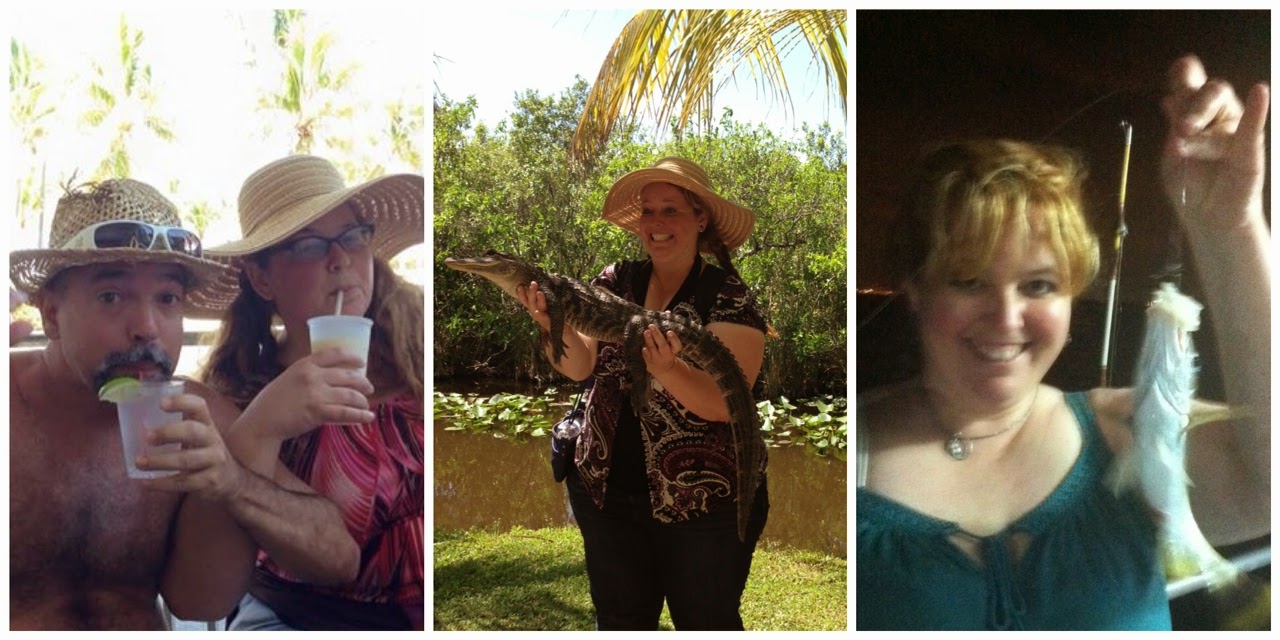
Florida wildlife: Michael White, a gator, and a "grunt" fish.

Which made it all the more difficult to head back to the fair. Workers grumbled that the days off kind of threw their rhythm out of whack. It was unusual, for sure, and I was glad to have the opportunity to go hang out with old pals, but I'm not sure I'd vote for that same structure next time around (ha, like we get a vote). It kind of felt like we were putting the fair-finishing celebration in the middle of the job instead of at the end. I and the other artists (and the rest of the fair folk) are really used to hauling ass for a few weeks and THEN getting time off.
By Lar de Souza

Otherwise though, the fair was much as I remembered it from last year. The clickety-clack of marionettes dancing hypnotically in the puppet booth near us. The overpriced fried food. The ants in the camper, and outside the camper, and around the camper. One of my hero artists, Lar de Souza, was moved by my Facebook complaints and kindly drew me as a "Carny Disney Princess" complete with ants and a vegetarian anteater sidekick. That made my week.

There were also the creepy clown garbage toppers. I have only seem them at Florida fairs, and they just . . . aren't right. In fact, Miami native Al-Rod even mentioned that he'd not been to the fair in years but remembers those things creeping him out as a kid. While they are all over the place in West Palm and Tampa, I only saw a couple of them in Miami. But, to my surprise, I got a photo message from a friend of mine visiting South America during that same stretch of time--and it was a picture of a fucking clown head garbage topper in Ecuador, where they were "inexplicably and unnervingly everywhere."
A Miami clown (left), a decapitated Miami clown (middle), and their Ecuadorian
 cousin (right). Though a little worse for wear, that South American clown is
 clearly from the same mold as others in Florida. Be afraid, be very afraid!

Now, I'm no conspiracy theorist, but the clowns are clearly up to something. Not sure if they are actually alien spawn crawling their way up (or down) the American continents, feeding on our refuse until they hatch from this latent form into who knows what . . . or if they have been planted there by government agents and genetically modified to eat certain children that wander by, thus controlling our population while they spy on us. But I'm fairly sure it's one of the two. Wake up, sheeple!

Oh yeah, and I drew pictures while I was there. Honestly, I wasn't too thrilled with much of my work this year. Maybe it was the sickness, or the days off, or the more leisurely pace with thinner crowds, but it took FOREVER to get into that "groove" we all strive for. Even with a less groovy groove, I'm glad I was there. I will still seek out retail stints like fairs, as a matter of personal development, for as long as I'm able. Gigging just does not give you the rounded experience as a caricature artist. Tipsy party guests who aren't paying for their picture can let you slide into mediocrity before you realize it. Working by yourself most of the time doesn't help. Nah, as aggravating as retail can sometimes be, I value those days where I'm working next to a bunch of other artists, with a critical, impatient, cheap grandma (or abuela) hanging over your shoulder judging your every line. That will keep you sharp. Or, at least, tell you when you're losing your edge. Or it might drive you bitterly out of the business--it can have that effect too. Results are not guaranteed.

There was one couple I remember pretty well, and I believe I gave them a nice picture--though I didn't photograph it. They were a couple of ladies, one more feminine and one more butch, who happily announced to me that they had just become engaged. They asked if I could put that in the picture. Well of course! I had done so for many couples before--one of them showing off the ring, the other smiling, both looking at each other, with a little heart that said "She said YES!" floating above them. Now, as I drew this picture I could not help but think about the new religious freedom laws in Indiana and Arkansas that were all over the news that same week. I hadn't realized it, but I am in an industry where I sometimes provide things for same-sex weddings. And here I was, in a situation where I could do a little thought experiment. I started wondering (silently, of course) what it would be like if I were religiously opposed to same-sex unions and chose to express that religion by denying these ladies a picture celebrating their engagement.

Wow, I thought, what an asshole move that would be. It would literally have ruined their day. And not in the typical "Oh my god do I look like that??" way that caricaturists can ruin your day. I mean in a demeaning, dehumanizing, hard-to-ever-laugh-about-later kind of way. What a stain on an otherwise special moment. As the hypothetical situation played out in my head, I literally cringed imagining the emotional harm one could do, even as a retail jockey selling a lousy $30 product (or AWESOME $30 product, as caricatures are).

But maybe I can invent a religion that requires me to refuse service to jerks. I could maybe get on board with that--goodness knows I've certainly put up with plenty of not-so-great people in my chair, and I've drawn them with a smile on my face simply because they had money and waited in line just like everyone else. Though I have heard some stories of ballsy artists rejecting customers (one of the other benefits to working a fair is that you hear stories of exploits on the road). At the Syracuse fair, one kid reportedly waited in line for 40 minutes with his girlfriend, then when they finally got into the artist's chair the smug teen said, "Twenty bucks to draw both of us, or we walk!" The artist chuckled, immediately motioned the kid away and shouted "NEXT!" His girlfriend looked angry and hurt as she skulked off with him, and she was likely rethinking her choice in the dating pool. Hopefully the young man learned a valuable lesson on haggling: it's completely ineffective if you have to wait in a line of eager customers first. One of my coworkers at this fair confessed that he had completely bailed on a picture a few fairs ago. The guy started with a request, then kept piling on more and more requests and warnings about how he didn't want it drawn, until he finally killed the artist's will to even begin the drawing. Without a word to the customer, the artist simply got up and left. Eventually the guy realized he'd been dumped and wandered away.
This baby was not a jerk (though she
did look worried as I started drawing). 

We all have moments when we'd rather not draw someone because they are drunk, arrogant, vain, obnoxious, argumentative, paranoid, cheap, or all of the above. But two ordinary, not-acting-like-jerk people in love? Hell, I'll draw that all day long, no matter what sets of genitals they own. The two ladies loved their picture, by the way, and I told them it would reduce well and make a neat save-the-date card if they felt so inclined.

And so ended the Miami County Fair. Even the long fairs, even when you're sick through them and business isn't great, and there's ants in your camper, you feel weird when it all comes to an end. Sara described it as "Fair Stockholm Syndrome," where you get used to the living situation and routine to the point where you kind of love it. But you hate it. But kinda love it. Sara and I had settled into a living situation like two primates at the zoo: she scratched my sunburned back and I picked stray hairs off her shirt for her. Then we'd screech angrily at people and fling our poop at them. Well, not really. But we thought about it pretty hard.

Until next time, Miami. Keep your eyebrows on fleek while I'm away.

P.S. A quick shout-out to Ali Thome, who has started doing a podcast on caricature called "It's Supposed to be Funny," available on Itunes, and Nolan Harris & Jon Casey who have been doing a podcast called "The Iscast" over on Soundcloud. Both of them are welcome additions to the caricature community, and I especially enjoyed Ali's last episode dealing with the whole "cookiecutter" debate that boiled over and got pretty divisive on a few Facebook pages last month. I look forward to listening to more of what they all have to say in coming episodes--and you should too!  


Sunday, February 15, 2015

A Friday the 13th to Remember!

Ready to draw! (No, not draw blood,
draw people).
You might know a few people who stay home on Friday the 13th because it's a bad luck day, and leaving the house for unnecessary errands would just be tempting fate. I not only left home, I drove a couple hundred miles and dressed up like a nurse! (Luckily there is a costume / fetish shop near my house where I was able to pick up a last-minute nurse's hat to go with super-red lipstick.)

See, I know a few people who see Friday the 13th as a great reason to throw a party. This past weekend I traveled to Southern California to participate in a really wacky event that is part outreach, part fundraiser, part "I dare you" party, and part reunion.
Margaret Downey introduces her volunteer staff of "doctors and nurses," ready to help "cure" the crowd of any lingering superstitions.

In addition to the table centerpieces, there was an area with
food  and food-related superstitions.
Margaret Downey, a longtime activist, equality warrior, and friend of mine, has been throwing these "Friggatriskaidekaphobia Treatment Center" parties in different parts of the country for nearly two decades now. The event always draws interest from the secular and skeptic communities, and news stations see it as an interesting angle to highlight during a dreaded Friday the 13th. As you may have figured out, "Friggatriskaidekaphobia" simply means "fear of Friday the 13th." It's not the only superstition highlighted at the event. A walk around the tables provides an educational tour of many historical and cultural-specific superstitions you might not have been aware of, as each table was topped with a unique centerpiece illustrating a particular item and it's superstitious significance.

This mid-1990s look for the MGM was putting off too many
rich Asian gamblers, who thought it was a little too close
to "walking through the mouth of a lion."
Superstition might be all fun and games (as certainly they were that evening), but many skeptic writers have explored and criticized how this type of thinking can be detrimental. Buildings avoiding the label of a 13th floor, people not shopping on unlucky days--all of it adds up to a dent in the economy and bizarrely missing elevator buttons. Here in Las Vegas there's a famous local story (one that cost our economy millions of dollars) involving the MGM lion. The gigantic Strip resort had invested much time and money into a glamorous art-deco lion entrance during the 1990s, but developers had to scrap the entire frontage soon after reopening. The architects had placed the main entrance right under the lion's mouth, and that's very bad mojo according to Asian superstition. So pretty soon the whole front of the MGM was scaffolded up again so the hotel could be resurfaced with better feng shui in order to entice wary (and highly superstitious) Chinese gamblers.

But economics aside, some superstitions are a deadly business (in a literal sense for both those words). There are some African superstitions that claim albino people can bring good luck--and not in a cheerful way, like you should befriend an albino person or buy them some coffee, because they are lucky to be around. No, to gain luck from an albino person you must (according to the superstition) steal parts of their body for use in magic spells and luck-bringing potions. The killing and mutilating of albinos, called muti murders, are a continuing problem in Africa. According to the Red Cross, at least fifty albinos have been murdered in Tanzania and Burundi in recent years, as Ben Radford mentions in a recent writeup for Discovery News.

Awwwwww! 
The anti-superstition bash at the Fullerton Howard Johnson was a lighthearted affair, however, so there was not much talk of death and murder. Black cats were brought out by the Kitt Crusaders, who facilitate adoptions and fostering of cats and were there to educate people on how black cats are adopted at far lesser rates (and therefore euthanized at much higher rates) due to the superstitious baggage associated with them. No one at the party was able to adopt then and there, but the cats got lots of cuddles and pets, and literature was taken home.

Now, I had drawn at a Friggatriskaidekaphobia party a few years back in Philadelphia, so I knew sort of what to expect. In fact, it was nice seeing so many folks walking around in a shirt I had designed: a few years ago Margaret had asked me to craft a logo for these treatment parties, and I'd settled on an adorable little rabbit amputee. That, along with a trash can full of luck charms, adorned the signs and t-shirts around the event. We even put up balloons (in bunches of 13) and there were little quotations about luck put up all over the ballroom. Margaret really does think of everything.
Ladder limbo!

I was introduced with an ambiguously hyperbolic "She is the best caricature artist in the world of skepticism!" . . . which I think is sort of like being the best tapdancer in the world of taxidermy. For a suggested donation of $13, guests could get their caricature at the party--and I did get things started with a few freebies just to warm up the crowd. It was hosted by the California "backyard skeptics" so I was to expect a little skepticism! In fact, many made that joke as they sat down. "I wasn't going to get one until I saw you were good--because, you know, I'm a skeptic, got to see it to believe it!" Those silly skeptics, jeeeeeez. But skeptical or not, they all plunked down varying donations, some quite generous, and I ended the night with over $200 to contribute to the hosting organizations.

Dancing under umbrellas, while "unlucky" added a fun little
  intimacy for couples hiding their pre-Valentine's day kisses!
As I drew, I got a nice view of the goings-on: there was a crowd umbrella dance, where couples swayed under open umbrellas on the dance floor as crooner Dave Deluca belted out some classic Frank Sinatra. Between musical acts and the dancing, Buck Bowen, the energetic emcee, led folks through ladder limbo, a ceremonial smashing of a mirror, and "level the leprechaun" bowling. Volunteers dressed to the nines as doctors and nurses put people through a superstition obstacle course of sorts, having them spill salt or duck under a ladder. There was a playfulness with all of it that helped people mingle and enjoy themselves. 
Some of the happy couples who (skeptically) sat in my chair at the party.
Once my time in the chair was up, I happily turned off my spotlight and headed to the drink gypsy (doesn't every good party have a drink gypsy?) and purchased one of her $13 "love potions." Normally I NEVER would imbibe at a gig, but this was a pro bono event for a friend, and these were my people. Little did I know, a $13 love potion would probably make up for all my previous parties of staying dry. It was sixteen ounces of solid alcohol and radiated a strange blue hue that should have warned me away from ordering it. Yeah, I got a little tipsy by the end of the night. (Thank you, Margaret, for kindly hosting me and driving to and from the party!)
Fangirling with Wendy Hughes.

As I nursed my giant blue radiation-infused drink, I was able to enjoy the skeptical comedy of Ian Harris, who delighted the crowd with his monologues about meandering through an irrational world. The horoscope rap done by Buck Bowen was delightful, and I even got to meet up with Wendy Hughes, who helps run TheOddsMustBeCrazy.com and contributes to the podcast Skepticality with stories of seemingly wild coincidences (then breaks down the odds with the help of statisticians).

There were a few luminaries in attendance that were not in the entertainment lineup. There were two fellows running around with a film camera and a fake mustache and wig, filming little snippets of the wigged actor "freaking out" over various superstitious omens. He asked one of my models if they were worried I was "stealing his soul" while I drew the caricature--the guy responded dryly "What's a soul?" A camera man and interviewer from one of the local news channels showed up. And Brian Keith Dalton, also known as "Mr. Deity," swung by. Luckily he enjoyed his time and we did not have to face his omnipotent wrath! Roy Sorge, retired captain of the Queen Mary, also attended.
Margaret checks Mr. Deity for signs of everlasting life.

A surprising guest was Mr. Scott Smith, a local photographer whom I did not even recognize at first. Last time I had seen Scott, it was the 1994 Northridge earthquake. He is the brother of my original cartooning mentor, Gary Smith, who lives and works in Baltimore, Maryland. Gary and I had visited southern California around the time I graduated college, and Scott had kindly hosted us (his home was just a few miles from the epicenter). I had joked about how cool it would be if there was an earthquake during our visit--and then immediately we got one! So Gary of course blamed the earthquake on me and said it was "very bad luck" for he and I to travel together . . . . so it was fitting to hang out with his brother again at an event refuting the very existence of luck and superstition!
Me (in sunglasses, because I was SO COOL) surveying the damage back in '94. I think Scott actually took this picture. Then there's me and Scott now, 21 years later. I think we held up pretty well--earthquake damage notwithstanding!

At the end of the night, Margaret and her head nurse Christine Jones did a little routine to the Secret Sisters' "Good Night, Good Luck, Goodbye" as they tossed (artificial) rabbits' feet into the crowd. Then the lights came up and many of the volunteers and some of the braver participants lined up in a group hug/dance, everyone swaying to John Lennon's "Imagine." It was a fun night of meeting new faces, reuniting with a few old friends, and learning new things. So glad I was able to be a part of it.

The next day was Valentine's Day, and I relaxed with Margaret and we swapped stories. She told me about various death threats she had received from Boy Scouts back when she was leading the fight in court to make them accept all boys regardless of religion or sexual orientation if they were going to use public money and be linked with the US military. Apparently Boy Scouts can be pretty graphic when describing how they're going to kill you, the Eagle Scouts especially! I've had no death threats aimed at me, personally--though a few coworkers had experienced the ol' death stare and "I'm gonna kick your ass!" from angered patrons who took offense to their caricature. And Margaret did enjoy hearing a few of the very very inappropriate offers I'd heard from drunk men (or couples!) while I drew them. I'm grateful for Margaret for fighting the fights, while I sit back and draw funny pictures. (Though the next day she texted me with news of the cartoon-inspired shootings in Denmark and said that maybe my job WAS more dangerous than hers.)

As a final bit of "good luck" after this event, the Southern California highways were clear and my drive home was smooth sailing! I may have to thank Mr. Deity for that little miracle--I was able to get back to my husband (and interrupt his bachelor anime fest) well before the stroke of midnight!


Tuesday, February 3, 2015

The Life and Death of a Retail Booth

Well, this is my 50th post. A milestone of sorts. And unfortunately, it's not a happy post.

Retail caricature artists everywhere know that the one constant in this business is change, and a booth near and dear to my heart has, unfortunately, succumbed to the changing tides here in Las Vegas.
One of my more recent shifts at the ol' booth.
(It was a Tuesday night, which explains my
ennui-fueled selfie.)

Doug Citizen ran the booth at Planet Hollywood's Miracle Mile Shops for over a dozen years--a good run by any stretch. I had first met Doug when he was an assistant manager for Steve Fasen's impressive Excalibur location. He became a booth owner soon after I started with Fasen. And, as the years went by and Fasen's presence dwindled, booth by booth, many artists who had cut their teeth at Fasen's locations ended up working at Doug's booth. With just two chairs it was never a crowded ship, but there were many who drifted in and drifted out. Robert and I stayed fairly regular there. It was only in the past year or so that we began filling our calendars more with gigs than with retail shifts. Even then, I valued the occasional night at the mall just to get some desk time and plow through commissions.
Robert shows off one of his more crowded
booth drawings, done from a class photo.

I doubt I'll ever work under a more pleasant "boss." And yes, I'm using scare quotes because as we all know, we aren't employees and they aren't supervisors, strictly speaking. As independent contractors, we work WITH them, not FOR them. Doug was generous to a fault with his operation, and that cultivated pretty strong loyalty with his artists. For quite a stretch of years Doug made a tradition of taking the whole crew out to midnight showings of anticipated movies: nothing beat closing up the booth and heading right to the theater with your coworkers. He offered a higher percentage than any other local operator and kept offering that same percentage even when booth finances changed to his disadvantage. There was even a stretch when foot traffic at the mall ground nearly to a halt. The Aladdin was transitioning to Planet Hollywood and its entire frontage was scaffolded up in a rather uninviting way. During that Dust Bowl-esque period, the businesses inside the Desert Passage Shops were all expected to stay open, much to the ruin of many proprietors. Doug told all of us to do whatever we had to. "Draw people for free, get tips, I know you all have families to feed." The five of us actually got together one night and had an informal meeting to see how we could make sure Doug got some part of the tips, since he was left out of the equation entirely. I think that marked the first time ever, anywhere, that a group of retail artists felt the need to meet because they felt the "boss" wasn't getting enough of a share of the profits. (He refused, by the way, to take any of our shilled tip money).
Doug, myself, and Rob gigging at some hotel, forget which.

But we weathered that, and had a few more good years afterward. The booth saw a few celebrities: Mike Tyson watched for a while, commenting on how cool the caricatures were. Chef Gordon Ramsay had his kids drawn there while he was in town opening his BURGR restaurant. (Rob drew two of the kids. To my disappointment, he told me Chef Ramsay was kind and had nothing but praise--he did not yell at Rob to draw faster, or criticize his technique, or call him a donkey.) I drew "Fieldy," the bass player from Korn; his wife said they collect caricatures everywhere the band tours. Criss Angel once walked by dressed as a woman, leading around three cigar-smoking, tattooed little people wearing diapers. As part of the goofy filler stuff they filmed for his "Mindfreak" show, he asked if I would draw his "little angels," to which I said "Uhhhh, can they sit still?" "FUCK NO!" said the cigar-chomping fellow in the diaper. Later on they were relaxing on a bench nearby and Criss looked down at his dress and laughed at himself, musing "What has happened to my career!" The little person in the diaper looked at him and said "Ha! YOUR career?" and snuffled.

Yeah, lots of good times at Desert Passage / Miracle Mile Shops. There were also the New Years Eves, where like clockwork we would come in and find vomit on our booth somewhere. And the many many tourists who could not hold liquor as attractively as their $60 light-up, shoulder-strapped souvenir cups.
Boredom comics by JW Cornelius and Rob.

And what are bored retail artists to do with this parade of life before them? We drew it. At Doug's booth we produced more than one or two little booth comics lampooning the mall culture and one another. Okay, "little" is an understatement, these things stretched on for over 50 pages. We illustrated panels featuring so many sick and twisted little happenings, giggling to ourselves as we awaited the night shift so they could see what we scribbled and then add to the plot. It's a darn good thing Doug was never officially my boss, because HR would have had quite a talk with me after I drew him naked, chained to a dungeon wall, recovering from being roofied by mall retail supervisors. Other complicated plots played out. Zombie hordes took over the entire mall. Old coworkers showed up with diabolical plans. Casinos came to life, sprouted mechanized arms, and did battle with each other like in a bad Japanese matinee. Genies popped out of lamps and sexually humiliated people. Artists went rogue, climbed the walls, and threw their own poop from the rafters.

Good times.

Wow, no one had EVER swept under there.
It was a somber moment helping Doug wheel the booth out to a U-Haul and chuck the worn-out drawers that had held our paper and plastic bags for so many years. As we pulled up the benches and floor mats, we uncovered years of detrius. I found a pencil sharpener I'd lost in 2011. As we took out the air compressor, unhooked all the lights, and prepared the hoist the rig onto wheeled dollies, sure enough two young ladies walked by and said "Oooooh how much are they? Uh . . . are you closed?" Yes, dears, we are so very very closed. Sigh. The landscape of the mall is changing--there will no doubt be a new kiosk there soon, selling magnetic therapy bracelets or giant plastic beads and sunglasses. You know, things for douchebags.

Tom Richmond recently touched on the shortgevity of retail booths and how the market viability of a caricature stand can suddenly change. His November 2014 blog post on theme park operations made me all the more aware of just how quickly things can end at any retail spot.

The landscape here in Vegas has indeed changed, and I'm wondering myself about the future of retail caricature anywhere here. The Stratosphere booth, where I sometimes warm a chair, is likely safe due to the ol' captive audience factor (getting up to the tower will cost ya $15, and once you're up there you want to do a few things before taking the long elevator down). The booth at Adventuredome is, I believe, still up and running--but if I recall they also have facepainting, illustrated names, the whole works. Doug's location had been the last remnant of airbrush caricature here, which I do love and find to be one of the most elegant ways to ply our trade. Freemont Street has a very nice decked-out booth, but the open-air market ambience means there is competition from buskers.
Goodbye, sweet booth, enjoy your slumber.

Buskers have blossomed all around the Strip like fungus. And I should not throw stones at the fungus among us: some of my friends busk. Some have even organized and have a person who hustles customers while others draw. Not a bad business model, I suppose, since it seems to be working. No rent to pay, and from what I understand it's legal as long as you don't have set prices. Much like all the celebrity lookalikes, the faux showgirls, and the guys in Transformer costumes, you just rely on the public to tip generously when they partake of your services.

It's the same kind of mentality we took on during our Dust Bowl year of construction at Miracle Mile. That was, I had hoped, a temporary way of doing caricature only borne of desperation. I do hope I'm wrong when I worry that this type of economy will put an end to standard caricature booths around town. Streetwalkers and pimps might do just fine, but I'm a brothel kind of madam. I like having a brick-and-mortar operation with quality artists and a place to set my jacket and lunchbox. It just seems more . . . stable? Surely, I have worked next to a couple of terrible artists here and there at booths. But on the whole, booth culture tends to lean toward a homogeny of skill; those who suck eventually get better with training, or are let go. Buskers can run the whole spectrum in terms of quality, as no one is herding those cats. Just look at Times Square in New York if you want to see what can come of a busking-only environment. Some good artists, surely, but many many more that are not skilled.
Sorry, no more caricatures here until further notice. 

If I can help it, I'll never fully give up retail. Not because it's a cash cow (boy is it not). But because it keeps your chops up and makes you work. Party guests are thrilled with their freebie souvenir drawings, but give me a picky grandma reluctantly shelling out $25 to get their grandkid drawn and THERE you have a challenge. THERE you have a level-up opportunity. Call me masochistic, but I like getting myself into that situation every now and then, it keeps me on my toes.

Retail booths will always be built on shifting sands. The management at any shopping venue often believes (wrongly) that a caricature booth can put up numbers similar to merchandise stores, when we are hindered by the fact that every item we sell has to be crafted on the spot. It takes ten or fifteen minutes, whereas a $8-an-hour teenager can sell $500 worth of Ed Hardy tee shirts in that same amount of time. Proprietors of caricature booths have to really talk up the atmospheric benefits of having live caricature art. People like watching us. If lower booth rent can be had, then there's hope. But there's always the chance that the rent might get upped the next year, or the next, either drastically or incrementally. Many folks operate at a loss for quite some time, hoping something will change. One of my first mentors in the business had to close up his shop in Baltimore after a long stretch of increasing rent and decreasing foot traffic finally used up his patience and his savings. His last words to the leasing team there, after they hiked his rent yet again, were "I've been bending over for you guys for years, the least you could have done was use lube."

I still get calls from people who are googling "Caricature in Las Vegas" and just want to find a place on the Strip to get drawn. I suppose I'll be telling them to look for the buskers now. And why not? Everything else in this town is a gamble, right?

Thank you, Doug, for all the years of steady desk time and camaraderie.

Wednesday, January 21, 2015

"Big Eyes" and "Cutie and the Boxer": Or, Celestia Yells at Movies about Married Artist Couples and Demands that the Females Grow a Pair of Lady Balls

Well, I'm not usually the sort to blog movie reviews, but in the past week I've seen two films that center on married artist couples. I'm a female artist married to another artist. So each of these movies struck me  as something I wanted to write a little about. Marrying another artist has its pitfalls (and its benefits). It can go afoul if the balance if not quite right. Power plays can happen if one of you is more profitable than the other, or more "artistic," or more anything--and that's going to happen, no two artists (or people) are perfectly matched. Navigating those inequalities can be interesting, or disastrous. Or just depressing. These movies struck me as cautionary tales, if nothing else, on how not to be a married artist team!

Spoilers below, so if you're about to see the movie, go do that first. Or read on, whatever, it's not like there are huge revealing plotlines in either film.

The first, a Tim Burton production (complete with music by Danny Elfman, of course), stars Amy Adams as Margaret Keane and the dynamic Christopher Waltz as her husband, Walter Keane. Those who already know the real-life drama on which the movie is based are aware of Keane's work: paintings of big-eyed waifs that rose to prominence (and were ridiculed by critics) in the 1950s and 1960s. I was vaguely aware of the historical fact that Walter took credit for these paintings and Margaret eventually sued him over it in 1986, winning the case after she painted a big-eyed waif in 53 minutes when the judge asked both parties to do so (Walter claimed a sore shoulder prevented him from displaying his talent to the jury). Everything I discuss below, however, is based on the movie, not the real life events. So please, I hope Ms. Keane and her estate take no offense if they ever come across this and read it.
One of the big-eyed Keane waifs.

The movie was entertaining, the music was peppy, and there are enough fun moments that it makes for a really enjoyable comedy/drama on the whole. My nitpicks below are born out from my being a female artist married to male artist, running a business and (so far) successfully navigating the pitfalls of clashing artistic egos and business decisions.

From the get-go, Amy Adams did not make the character of Margaret likable, at least not for me. She chokes back every one of her lines, using a stilted voice that sounds like she's trying to only use half of her vocal chords. And of course, she has trouble selling her art or even explaining why she creates art. In a scene many caricature artists will identify with, she offers her big-eyed portraits at an outdoor fair, only to have a customer compliment her work and then smugly offer her half the asking price for a drawing. (In a continuity gaffe, I noticed she was working with a half-size French easel, like the one I own, during the shots in the park, and then later she was carrying a full-size French easel out of the park--just a little easter egg for those of you who know your portable easel types).

Amy Adams, as Margaret Keane, finds little success drawing at art fairs.
Enter the spry, energetic, and very charming Walter Keane. He sweeps her off her feet, compliments her work, tells her she is devaluing herself by accepting lower prices, and proposes marriage to her fairly quickly in an effort to help her retain custody of her daughter. Soon he confesses to her that he's actually not a painter, just really admires the craft and wants to be a painter--but his actual job is commercial real estate and he's pretty successful at it. While Amy Adams' Margaret is taken aback and hurt by this revelation, I sat there thinking "What? He has a steady income from commercial real estate? That's friggin' awesome! Marry that dude!" So far so good, right? Waltz is a very likable actor--whether playing a Nazi or an old west dentist/bounty hunter, the guy really is a huge heaping pile of charm. I'm quite sure I was rooting for him in Big Eyes far longer than the average movie patron.

The movie paints the situation as quite a natural fit, at first. Margaret is utterly useless when it comes to selling work, but Walter has the touch. He sees marketing opportunities everywhere and makes inroads with local personalities that can help his and his wife's art careers. Through what is portrayed as a misunderstanding, he takes credit for one of her paintings and ends up selling it that night--and that gets the ball rolling. Soon he is pretending that all her big-eyed waif paintings are actually his work, and the patrons are snapping them up. Margaret is hurt at first, but eventually just seems to go along with it even though it means keeping a big secret from her daughter. She wants credit for her paintings, deep down, but of course she is weak and frightened and ignorant of the ways of the world and can barely utter a full sentence much less pimp her paintings to the critics and the masses.
Walter secures wall space for the two of them, but it's in
a bad location where people just walk by and ask where
the bathroom is. KNOW THAT FEELING, anybody?

Here's where I kind of diverged from the intended movie structure. And call me a lousy feminist if you want. In the world that the movie sets up, and with the personalities the movie portrays, it was really hard for me to see Walter as a full-on villain for most of the film. Margaret was so ineffectual, and so terrible at being in the limelight, that it became clear that without Walter, the big-eyed waifs would have remained obscure, and she would have remained impoverished, trying to get a dollar a piece for caricature-ish portraits at outdoor fairs. The guy really did have some ground-breaking ideas. He opened a gallery, he gifted celebrities and local politicians with new paintings, and he became a media darling. He was good at being the face of the business. Observing how many gallery posters were stolen or snatched up by people who could not afford the paintings themselves, he pioneered the idea of making low-cost prints and selling them. I sat back and thought "Wow, this guy is actually bringing a lot to the table--and all Margaret has to do is paint the things!" (I think many people who run an art business might have had the same thought during the movie--we realize that making the art isn't necessarily the most labor-intensive part of the process!)

Sure, he was getting credit for the work. But the movie also points out that, during that era, female artists had a lot of trouble securing gallery showings or getting any respect for their work. She could have used Walter as a puppet, a commercial front for her own work, for decades, and reaped the benefits of fame and fortune without the annoying downsides of being recognizably famous. The actual "being famous" part was something Walter obviously enjoyed--and, given the temperament that Amy Adams played her with, Margaret might not have been able to handle fame at all had it been thrust upon her! She could have been an active partner in plotting their big-eyed empire and, given time, even planned some future grand revelation about who was really behind the paintings. In some perfect teamwork situation I imagined Walter being on board with that, making some statement that their grand switcheroo was a demonstration and indictment of chauvinism in the art world--these paintings did not sell when they were painted by a female, but look at how valuable they became under his name! I could see Andy Warhol digging that publicity stunt.

But no. And it didn't go that way in real life, so I cannot expect a movie about the Keanes to go that way. It would not have any sort of conflict necessary to make a movie if it did! So naturally, as the movie drives toward its climax, Walter becomes an ogre and his ego turns him into a slave-driver rather than a helpful partner. And of course, you hate him for it and feel bad for poor Margaret. Some of the scenes showing Margaret as a trapped, downtrodden soul went a little overboard in terms of believability, though. In one climactic scene she is terrified of a stumbling, falling-down drunk Walter as he menaces her and her teenaged daughter. He starts lighting matches and tossing them at her, and the terror Amy Adams brings forth is over the top. They are matches, tossed by a drunk. You know what you do when a falling-down drunk is coming for you? You step aside and watch them fall down, drunk. It's not difficult, I've done it myself (thankfully, not in a situation of threatened domestic violence, but I have been in the presence of extremely drunk men before, and I have had to dodge them). When someone like that tosses matches, you pinch out the match flame so that nothing catches fire. All I could figure was that maybe both Margaret and her daughter were soaked head-to-toe in hair spray and thus were highly flammable, perhaps? It was the 60s. That would account for the extremely terrified reaction of both of them when a few matches were tossed their way.
Waltz's Walter Keane before he goes from Prince Charming
to Prince Alarming.

Ah, I'm failing to get myself into the mindset of an emotionally abused woman. That must be it. Forgive me. It's difficult, especially in the span of a 106-minute movie. I am a large woman with a very strong sense of self, and brothers that taught me to fight, and enough contact sports under my belt that I tend to see movie scenes like that in a different way. A tactical way. Drunk guy coming for you? Well, hey, look how easy it would be to trip him. Or look at that heavy object nearby, use it on his skull, you nitwit! Oh no, wait, you're going to scream and cower and behave in the typical cinematic damsel style. Sigh. It makes it very hard to root for you, lady.

They do portray Margaret as very weak-spirited and unable to do much without help. There are obvious parallels between her and the victim-like waif children she paints. She first needs Walter's help, then she dives into numerology and seems to get some strength from that. Then, finally, she is visited by Jehovah's Witnesses and embraces that mindset as a way to find strength that she, as an individual, always seemed to lack. Her reason for taking Walter to court finally turned on whether or not the fraudulent way her paintings were marketed constituted "lying," which was a sin in Jehovah's eyes. She had separated from Walter by now and clearly, deep down, she had always wanted credit for her work. But that desire wasn't enough, she needed some other crutch to help get her willing and ready to fight for it.

It was, of course, very satisfying seeing Margaret finally wrest credit from her (by now) delusional, self-aggrandizing, control-freak parasite of an ex-husband. The courtroom scenes provide quite a few laughs, and the judge's no-nonsense approach to settling the matter is simple and to the point. He asks them both to paint, and only Margaret can. She walks out of the courtroom holding the finished big-eyed waif painting in one hand and her daughter's hand in the other. The transformation from weak to strong is supposed to resonate here, and it does. It almost makes me forgive the filmmakers for how she is portrayed for the first 98 minutes of the movie. Almost.


The second movie I saw this week about a married pair of artists was the somewhat depressing 2013 documentary Cutie and the Boxer, which follows the 40-year marriage of "boxing painter" Ushio Shinohara and his wife Noriko Shinohara. It was recommended by a friend and had a 96% rating on Rotten Tomatoes, so I was ready for a great flick. It was readily available on Netflix and so we were in luck.

It was not really a feel-good movie. It did not make one feel inspired or proud to be an artist, nor did it give the impression that artists marrying artists was a good idea. About fifteen minutes into the film my husband Robert said "I really do not like this guy."

The guy in question was 80-year-old Ushio, who we see in several ways: in the present day, as the somewhat doddering old man who has developed an allergy to alcohol but still puts on his paint-soaked boxing gloves and whacks at canvas in his cluttered Soho warehouse; then, in archive footage as a smiling younger rebel of an artist that whacks at canvas wearing boxing gloves and also hangs out with Andy Warhol; and, finally, in Noriko's painterly cartoons of him as a "true artist" who drunkenly carouses with friends, borrows money from her, and plunges her into an impoverished life where she has trouble raising their child.

Ushio's work is large and bold and bizarre, great big cardboard sculptures of spiked motorcycles and huge swaths of canvas filled with vivid streaks and splotches. He says at the film's start that Noriko is "just an assistant" and her job is to support the true genius. I wondered if he was just tongue-in-cheek kidding about that, the way old couples taunt each other. Rob thought he was dead serious.

"Please tell me I was never like that to you," he asked me as we watched. "Please tell me I was never like that to you!" I said back to him.
Ushio SMASH!

Noriko is shown as the ever-present wife, who bears many burdens but gets no credit for her accomplishments. She states outright that he has her only because he cannot afford to hire anyone to do all the things she does for him. The filmmakers animate her biographical cartoon drawings of "Cutie and Bullie," little representations of herself and her husband that tell the story of their courtship and difficulties according to her. Cutie is always naked in the drawings, she says, because she is so poor.

There is clearly resentment, and money trouble, and a question of whether Noriko has wasted her life on this man, this artistic soul she met when she was a 19-year-old student. The filmmakers do not try to simplify the complex relationship, nor do they candy-coat it. Every marriage is complex, but one would hope the good bits outweigh the bad. In this movie, I did not come away feeling that. They discuss their adult son's alcoholism, they live in a hoarder-like environment, and they are perpetually short on the rent. Through all this, Noriko seems to have a sense of grace and tired elegance. She is downtrodden but ladylike. Ushio smacks his food, quibbles with her, and cooks "celery hamburgers" for the family much like a child might. He does not drink anymore, but Noriko explains it was because he developed a medical intolerance for it. One wonders what the documentary would feature if he were still able to imbibe. Though Ushio is more than twenty years her senior, Noriko too has grey-white hair and the eyes of an octogenarian. "Living with that man has aged her before her time," Rob judged.
Noriko and Ushio in the gallery room featuring her larger painted versions of Cutie and Bullie. 

In the end, the film tries to frame Noriko as a victor of sorts. She gets to share a gallery show with her husband, where she displays large painted versions of her "Cutie and Bullie" cartoons. When going through the drawings with a friend, she states ominously that they cannot have a happy ending because that would not be the truth. At the show, though, she rationalizes that she would marry him all over again because she needed the suffering, for her art. And, as some kind of "happy ending" after all, the drawings she reproduces on the wall show Cutie triumphing over Bullie, getting a pair of red shoes to wear, and sitting on him as she wrests control.

And the end sequence is a kind of adorable slow-motion boxing match between the two, with Noriko landing every punch and coating her husband in bright paint.

I'm not sure Cutie did triumph over Bullie. I think she just waited him out. He grew old, he could no longer drink, and he became manageable. If this is a victory, I would say it's a victory won by the infinite capacity of woman to bear suffering gladly.

Some women. Me, personally, I would never have had the patience.

Thursday, January 15, 2015

Je Suis Froussard: What Charlie Hebdo Has Taught Me (So Far)

I have not been looking forward to writing this post. But I can't really call myself a caricature blogger and ignore it.

The media saturation of the topic has been pretty solid this past week. Or at least it has seemed so from my vantage point (with about two hundred artists on my Facebook feed, and as an avid listener to public radio, which has given it much coverage).

On Wednesday, January 7th, twelve people, among them the editor in chief and four cartoonists, were killed at the offices of satirical magazine Charlie Hebdo, in Paris. The next day a policewoman was gunned down. And then, finally (let us hope it is a final count), four more lost their lives in a kosher grocery during a standoff with the gunmen presumed responsible for the original attack on the magazine.
Rather than a somber photo of Charb, I am going to show
you a drawing of his that made me giggle. The French and
the English have a bromance of sorts, having lampooned
each other for centuries upon centuries (this caption reads
"But who wants the English in Europe?").

Stephan Charbonnier ("Charb"), the editor, knew he was a target for a long while. The magazine's offices were firebombed in 2011, and Charb was featured in a "wanted dead or alive" poster in an Al Queda magazine in 2013 (I know, I thought it too: "WTF, they have an official magazine???"). His attitude was fairly brazen about the dangerous hackles he was raising: "And when the government asks us not to do any provocation, we have the impression that three idiots who demonstrated in the streets represent all of Islam. It's the government who insults Muslims by saying that. You have to take them as they are. One has to mock them using humor, disarm them with humor and not give them any credit. By taking them seriously and sending regiments of riot cops to hold them, one takes them seriously."

I want to say that this type of bravery in the name of free speech, artistic expression, and separation of church and state, and the right to mock anyone and everyone is a very American thing . . . but it's not, really. It's more a French thing.

Our word caricature originates from the French word, and there are many early French caricaturists that come to mind: Daumier, Philipon, Guillaume, and so on. There is a reason I often wear berets to my gigs, and why Chelsea Peretti put on a ridiculous French accent when she made fun of Jeff Pecina (see my last post). The French are kinda historical smart asses, they have been linked to caricature's roots in our consciousness even if we don't know the names Philipon or Daumier.

As a lighter historical digression, let me tell you about Charles Philipon and one of the most successful political caricatures of all time.

In the early 1830s, after a July revolution put a new king upon the French throne (Louis-Pilippe), there was still unrest and criticism of the new leader. Artists and satirists attacked him, softly at first but more and more ruthlessly, often in a publication called La Caricature. Philipon drew the king carelessly blowing bubbles, each representing false promises like freedom of the press, popping in the wind. Ironically, that drawing landed him in court. As did another cartoon he drew of the king as a mason, fixing a wall and erasing traces of the July revolution. On November 14, 1831, Philipon is again in court and performs a demonstration that became, it could be argued, one of the first viral memes.

He defended his caricatures of the king by claiming that it was not his fault that "everything can look like the king." To illustrate, he drew a series of caricatures showing the king morphing into a pear. Though Philipon was sentenced to jail time and a hefty fine, the success of the image, this caricature, was immediate. As he recounts in a letter: "The people, seized by a mocking image, a simple image design and a simple shape, began to imitate this wherever he found a way make charcoal image smearing, scratching a pear. Pears soon covered all the walls of Paris and spread to all the walls of France."

The pear came to symbolize the king, his corrupt regime, and all his cronies, and it helped galvanize the population against him. Other artists began to use the image of a pear. Louis-Philippe, the Pear King, eventually had to abdicate the throne in 1848 and lived out the rest of his life in exile.

So France has a history of caricature being a very powerful weapon, and popular force. Their media is shaped by this, it has a cultural memory.

R. Crumb, an American cartooning legend who has been living in France for a couple decades now, gave a lengthy and insightful interview about the Charlie Hebdo massacre and his thoughts on the media differences between his two home countries. "You don't have journalists over there anymore, what they have is public relations people. That's what they have over in America now. Two-hundred and fifty thousand people in public relations. And a dwindling number of actual reporters and journalists." He also went into the French tradition of merciless political satire and said "It's a French thing, yeah, and they value that very highly here."

The cartoons were very insulting and offensive by design. That strikes Americans as nonsensical. We like smart, we like funny, and we can put up with a little poking, but we are much quicker to see things as hate speech. And we really hate hate speech here.

Both of these are rude and immature photos. One of them is
a crime in Pennsylvania. But perhaps with lobbying we
can protect Ronald McDonald from desecration as well. 
We also still have plenty of sacred cows. Just a few months ago a 14-year-old in Pennsylvania was brought up on charges and could have faced 2 years in jail for taking a photo with a statue of Jesus. Let me repeat that. He was facing two years in jail, in America, for taking a photo. The statue (which was in a public place, he did not trespass) was undamaged, he simply stood in front of it at an angle that made it look like Jesus was, ahem, doing something very lewd. It was absolutely exercising free speech, absolutely should have been protected under law, and it happened here on our soil. And that's how it was dealt with. The kid was given probation and community service, and he was banned from using social media. His "crime" fell under a Pennsylvania law defined as "defacing, damaging, polluting or otherwise, physically mistreating in any way that the actor knows will outrage the sensibilities of persons likely to observe or discover the action."

So in Pennsylvania, you'd better not outrage someone's sensibilities. I wonder how Pennsylvania cartoonists feel about that law.

I was working a big convention during the days that the massacre unfolded. And normally I would never chat with clients or caricature guests about a divisive, controversial topic while I'm doing my job and in "public-pleasing" mode. But the last guy I drew was from Paris. So it came up. Very briefly, very tentatively, we discussed the state of things in France and he filled me in on the latest news there (the gunman and hostages had just been killed mere hours ago, which was news to me). Well, a bystander overheard our talk and butted in with "Well have you SEEN the cartoons? They were REALLY offensive."

I stopped short for a moment. I did not know the victims. But I know people who knew them. I felt a kinship. And here's this guy, saying that over my shoulder, and in my mind I instantly imagined him defending a rapist, saying "Well, did you SEE what she was wearing? It was REALLY slutty."

Now, standing up and slapping him for that statement would have probably not gone over well with my corporate client. And it would have been answering offensive speech with violence, which is exactly what the Paris tragedy was. So I put on a nice face and just said, as neutrally as I could, "Well, I can't imagine any cartoon, of any level of offensiveness, that would justify murder." The guy shrugged. My Parisian friend in the chair looked irritated but left it at that.
Some friends just don't photograph well. 

That guy was one of many examples of why America is not Charlie Hebdo. There's a feeling of cognitive dissonance going on when we rally about freedom of speech but then say "Oh but they were such racist cartoons, I mean, that was hate speech." Jeffrey Goldberg summarized this well in his piece for the Atlantic Weekly, "We Are Not All Charlie Hebdo."  He points out the ridiculous bravery of those working at Charlie Hebdo: they continued to publish those rude satires of radical Islam even AFTER their offices were firebombed in 2011. No American outlet would have done so. Matt Smith and Trey Parker were reigned in pretty immediately and their infamous Mohammed episode of South Park was redacted by the network back in 2010. Comedy Central was not firebombed, they just thought maybe they might get a violent response. That was enough to put on the brakes.

Molly, it sucks to be you. I'm so sorry. I hope things change.
Now, I'm willing to admit my own hypocrisy and cowardliness here. I'm not including my own drawing of Mohammed in this blog post. But I will talk about Molly Norris, who started "Everybody Draw Mohammed Day" back in 2010 right after the South Park brouhaha. Here images were benign to the extreme: Mohammed as a domino, a thimble, a teacup. It was something she posted as a lark on Facebook.

Within a day she got death threats. She has been in hiding four years now, with a new identity, at the recommendation of the FBI. Her friend Larry Kelley, who started a foundation trying to help fundraise for her, says that law enforcement did not do enough to protect her. "The example of Molly Norris shows you we are not even playing defense when it comes to threatening the journalistic community." On his blog he states "Norris is the first casualty in the campaign to Islamify America. And we let them take her down without a whimper."

I do not know if Molly was given any choice in the matter, and I'm not calling her a chicken for going into hiding. But I'm holding this American example up in stark contrast to the way things played out after the firebombing of Charlie Hebdo. The government assigned more security, there was a guard there at all times, and the cartoons kept on coming. Did the cartoonists know they were taking a humongous risk? Well yes of course, they weren't stupid!

Much has been said of how the artists at Charlie Hebdo were part of that elite, hard-edged group of "underground" artists who came of age in the 1960s and seemed constantly tilting at the windmills of politics and religion. Crumb mentioned in his interview, "He knew . . . he said that thing about, you know, 'I'd rather die standing than live on my knees,' he said 'You know, I'm not married, I don't have credit cards, I don't drive a car. I stay very . . . I keep everything very simple . . . I don't want to have these connections, because I could go at any time.' He knew that. "

These guys knew they would more likely than not become victims. Martyrs to free speech, if you will. I find that bone-chilling. And admirable. And it takes a load off me. They were brave, and insulting, and rude, and crass, and subversive for me. For all of us. So I may go with R. Crumb on this and call myself a cowardly cartoonist (as he did, slyly, in his contribution to the many cartoons being circulated about the tragedy).

I am a chicken. Sorry.
But I hope that some of Philipon's spirit is still around. I hope that through the mass exposure this event is getting, through the courage of many individual people, whose ancestors scratched charcoal pears onto walls, we can elevate the notion of free speech. And "elevate" in this sense means "lower"--for you cannot have free speech if it means "only for things that are high-brow and inoffensive." Hate speech should not be a crime, only hate action.

Charb, Tignous, Wolinsky, Cabu, Honore, do not rest in peace. Rage on, through your work and through your sacrifice, so that the rest of us can be inspired. Taunt on, brothers and sisters, taunt on.